Table of Contents
ToggleIntroduction to Turaska
Understanding Ancient Terminology in Modern Context
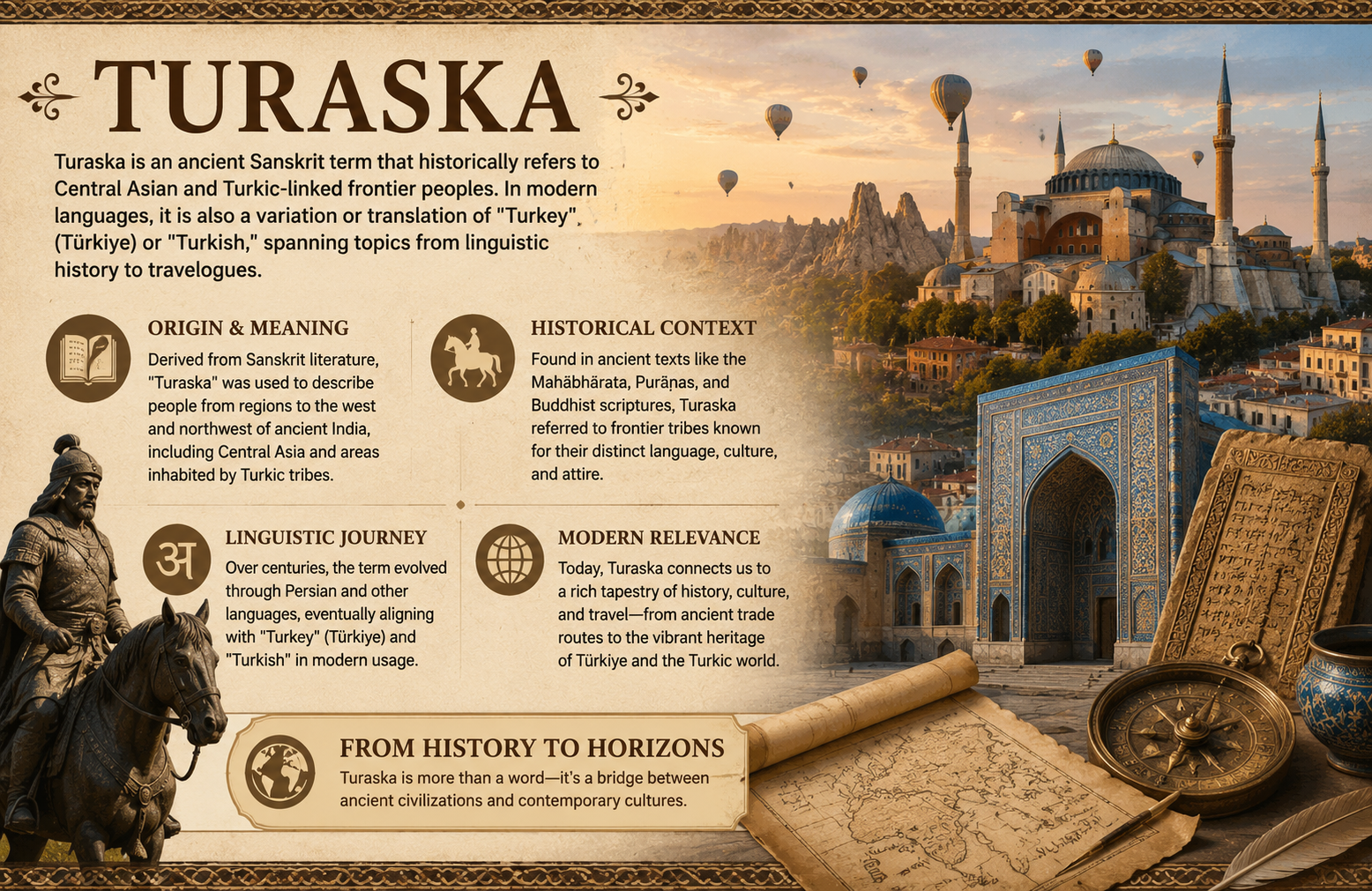
Turaska represents an ancient Sanskrit term carrying significant historical and linguistic importance, referring to Central Asian and Turkic-linked frontier peoples in classical texts. Rather than being purely historical artifact relevant only to scholars, Turaska demonstrates fascinating connections between ancient linguistic traditions and modern language, revealing how terminology evolves across centuries and cultures. The term, which appears in ancient Sanskrit literature and historical documents, represents window into how ancient civilizations understood and referred to neighboring peoples and regions. In contemporary usage, Turaska functions as variation or translation of modern “Turkey” (Türkiye) or “Turkish,” demonstrating linguistic continuity connecting ancient Sanskrit traditions with modern European languages and geographic terminology.
Bridging Ancient and Modern Understanding
The existence of Turaska in ancient Sanskrit texts while simultaneously connecting to modern “Turkey” exemplifies broader patterns in linguistic evolution and cultural contact. Ancient Sanskrit speakers, living in what is now India and surrounding regions, developed terminology to describe peoples and places they encountered or knew about through trade, travel, and cultural exchange. The term Turaska, applied to Central Asian and Turkic peoples, represents this ancient geographic and ethnic understanding. That this same term or similar variations continue appearing in modern language usage as “Turkey” or “Turkish” demonstrates remarkable linguistic continuity spanning thousands of years and multiple language families.
Historical Significance
Understanding Turaska requires appreciating its significance within ancient Sanskrit texts and historical record. Sanskrit, one of world’s oldest documented languages with rich literary tradition spanning millennia, provides crucial evidence regarding how ancient societies understood geography, ethnicity, and distant peoples. References to Turaska in Sanskrit texts offer valuable insights into ancient trade networks, cultural contact, and geographic knowledge. Scholars studying Turaska contribute to broader understanding of ancient world and how different civilizations conceived of distant regions and peoples.
Modern Linguistic Interest
Contemporary interest in Turaska extends beyond purely historical scholarship to encompass broader linguistic studies examining how terminology evolves across centuries and languages. Turaska serves as case study in language evolution, demonstrating how Sanskrit terms influenced or paralleled development of modern European language terminology. The connection between ancient Sanskrit Turaska and modern “Turkey” interests linguists, historians, and scholars examining language families and cultural contact across time periods.
Ancient Sanskrit and Historical Context
Sanskrit as Ancient Language
Sanskrit represents one of world’s oldest documented languages, belonging to Indo-European language family. The language possesses extraordinarily rich literary tradition spanning thousands of years, with texts preserved in remarkable detail through centuries of careful transmission and scholarship. Sanskrit texts document ancient Indian civilization, provide philosophical and religious teachings, describe history and mythology, and contain references to distant lands and peoples. Sanskrit’s sophisticated grammar and extensive vocabulary enabled ancient Sanskrit speakers to describe complex concepts, distant places, and neighboring peoples with considerable precision and nuance.
Dating and Historical Period
Turaska appears in Sanskrit texts spanning various historical periods, though precise dating remains subject to scholarly debate. Ancient Sanskrit literature, including epic texts like the Mahabharata and Ramayana, contains geographic references potentially including or relating to Turaska and Turkic peoples. These texts, composed over centuries and preserving knowledge accumulated across generations, provide crucial evidence regarding ancient understanding of Central Asia and surrounding regions. The presence of Turaska in Sanskrit texts suggests that even in ancient times, Sanskrit speakers maintained awareness of Central Asian peoples and regions, suggesting active cultural contact through trade networks or other interactions.
Sanskrit Literature and Geographic Knowledge
Sanskrit texts reveal sophisticated geographic knowledge regarding regions far from Sanskrit speakers’ primary settlements. References to distant lands, peoples, and trade routes appear throughout Sanskrit literature, suggesting active engagement with distant regions. Turaska, as reference to Central Asian and Turkic peoples, demonstrates Sanskrit speakers’ awareness of important neighboring civilizations. The specificity of terminology like Turaska suggests not mere abstract knowledge but rather practical familiarity developed through trade, diplomatic contact, or cultural exchange across Central Asia.
Transmission and Preservation
Sanskrit texts have been remarkably well preserved through centuries, thanks to systematic scholarly traditions emphasizing textual accuracy and transmission. Hindu, Buddhist, and Jain scholars developed sophisticated methods for preserving texts with minimal error, ensuring that ancient knowledge remained available to subsequent generations. This careful preservation enabled modern scholars to access ancient Sanskrit texts and study terminology like Turaska within original contexts. The preservation of Sanskrit texts represents one of humanity’s great intellectual achievements, enabling contemporary understanding of ancient civilizations and their knowledge.
Turaska in Historical Geographic Context
Central Asian References
Turaska appears in Sanskrit texts as designation for Central Asian peoples, particularly those connected to or identified as Turkic. Central Asia, historically crucial crossroads of civilizations and trade routes, represented important region for ancient Sanskrit speakers to understand and name. The vast steppes and trade routes of Central Asia connected multiple civilizations, facilitating exchange of goods, ideas, and knowledge. Turaska’s use to refer to peoples of this region reflects Sanskrit speakers’ recognition of Central Asian significance and their attempts to classify and understand diverse peoples inhabiting or passing through this important geographic zone.
Turkic Peoples and Ethnic Designation
The connection between Turaska and Turkic peoples appears significant to understanding term’s meaning and usage. Turkic peoples, who came to dominate Central Asian regions in later historical periods, were understood by earlier Sanskrit speakers through designation like Turaska. While precise ethnic boundaries and identifications remain subject to scholarly debate, Turaska apparently referred to peoples either ethnically Turkic or inhabiting regions later dominated by Turkic peoples. This ethnic dimension of Turaska demonstrates how ancient Sanskrit speakers attempted to categorize diverse Central Asian populations.
Frontier and Border Significance
Turaska’s designation as referring to “frontier peoples” carries particular significance. Frontier regions, occupying boundaries between major civilizations, typically hosted diverse populations engaged in trade, migration, and cultural exchange. Turaska appears to specifically reference peoples occupying frontiers—regions between Indian civilization where Sanskrit originated and more distant Central Asian regions. This frontier designation suggests Turaska referred not to a unified political entity but rather to diverse populations inhabiting regions between major settled civilizations. Understanding Turaska requires appreciating these frontier populations’ complex identities and their position between multiple civilizational spheres.
Trade Routes and Commercial Contact
Central Asian trade routes, particularly the famous Silk Road, connected Sanskrit-speaking regions with Central Asia and beyond. These trade networks facilitated not just commercial exchange but also cultural contact, knowledge transmission, and geographic awareness. Sanskrit speakers engaging in trade or receiving reports from traders would have developed practical knowledge of Central Asian peoples and regions. Turaska, as designation for these peoples, likely developed through such commercial and cultural contact. Understanding Turaska therefore requires appreciation of ancient trade networks and how they facilitated knowledge of distant regions.
Etymology and Linguistic Evolution
Sanskrit Root and Meaning
Turaska’s etymology within Sanskrit reveals aspects of how ancient Sanskrit speakers approached terminology for foreign peoples. The term appears related to “Turk” and variations, though precise etymological connections remain subject to scholarly discussion. Sanskrit terminology often reflected either phonetic similarities to foreign language names or characterized foreign peoples through particular attributes. Turaska’s etymological structure and relationship to modern “Turk” terminology demonstrates linguistic continuity spanning millennia, suggesting either direct transmission or parallel development of similar terminology across different language families and time periods.
Connections to Modern “Turkey” and “Turkish”
The evolution from ancient Sanskrit Turaska to modern “Turkey” or Turkish-related terminology demonstrates fascinating linguistic journey. While direct etymological lineage versus parallel development remains debated among scholars, the similarity between Sanskrit Turaska and modern “Turkey”/”Türkiye” appears too significant to be coincidental. Modern Turkish “Türkiye” or English “Turkey” likely derives from similar roots referencing Turkish peoples, suggesting that terminology for describing these peoples has remained remarkably consistent across centuries and language families. This linguistic continuity suggests deep historical connections in how different peoples referred to and understood Turkic identity and origin.
Linguistic Pathways and Transmission
Understanding how Turaska terminology evolved into modern forms requires examining linguistic pathways and historical transmission. Sanskrit terminology likely influenced languages Sanskrit speakers contacted through trade and cultural exchange. As Central Asian peoples developed their own writing systems and languages, they may have adopted or been influenced by Sanskrit terminology. When European languages later encountered Turkish peoples and attempted to describe them, terminology might have been influenced by earlier Arabic, Persian, or other linguistic traditions already incorporating Sanskrit-derived concepts. Turaska thus represents linguistic archaeology revealing layers of cultural contact and knowledge transmission.
Phonetic Evolution
Examining phonetic evolution from Sanskrit Turaska to modern “Turkey” provides insights into how sounds change across languages and centuries. Sanskrit phonetic system differs significantly from modern European languages, making direct phonetic comparison complex. However, consonant patterns (T-r-k) remain consistent from ancient Sanskrit to modern terminology, suggesting significant continuity. Vowel changes and phonetic adaptations reflect how foreign terminology was integrated into different language systems, each language’s phonetic rules modifying borrowed words to fit native patterns. This phonetic evolution demonstrates predictable patterns in how languages adapt foreign terminology.
Turaska in Sanskrit Literature
Epic Texts and Geographic References
Turaska and related terminology appear in major Sanskrit epic texts including the Mahabharata and Ramayana. These vast literary works, composed over centuries and representing accumulated cultural knowledge, contain geographic references indicating Sanskrit speakers’ understanding of distant regions. References to Turaska in these epic texts provide context regarding how Sanskrit speakers understood Central Asian peoples and their place in known world. The epic texts’ treatment of Turaska and other foreign peoples reveals not just geographic knowledge but also cultural attitudes and stereotypes regarding distant regions.
Scholarly Commentary and Interpretation
Sanskrit scholars, particularly commentators working in medieval and early modern periods, provided interpretations of Turaska and other geographic references in ancient texts. These scholarly traditions, maintaining continuity with ancient texts through careful transmission and exegesis, offer valuable insights into how later Sanskrit scholars understood ancient terminology. Their interpretations inform modern scholarly understanding of Turaska’s meaning and significance. The existence of scholarly commentary traditions demonstrates that Turaska’s meaning and significance remained matters of scholarly interest across centuries, not merely ancient historical curiosities.
Travel Narratives and Travelogues
Sanskrit literature contains travel narratives and descriptions of distant lands, suggesting Sanskrit speakers engaged with and developed knowledge about Central Asia through various means. Some Sanskrit texts, functioning as early travelogues, describe journeys to distant regions and encounters with foreign peoples. These narratives provide context for understanding Turaska within broader framework of Sanskrit speakers’ geographic knowledge and cultural understanding. Travel narratives demonstrate that knowledge of Central Asia and peoples like Turaska wasn’t abstract but grounded in practical experience and direct observation.
Historical Chronicles
Sanskrit historical chronicles, attempting to document historical events and genealogies, occasionally reference Turaska and neighboring peoples. These chronicles provide chronological frameworks for understanding when and under what circumstances Sanskrit speakers encountered or developed knowledge about Central Asian peoples. Historical chronicles’ treatment of Turaska contributes to scholarly understanding of trade relationships, military conflicts, and cultural exchanges involving Sanskrit-speaking regions and Central Asia.
Modern Usage and Contemporary Significance
Translation and Linguistic Variation
In modern usage, Turaska functions as variation or alternative translation of “Turkey” or “Turkish,” bridging ancient Sanskrit terminology with contemporary geographic and ethnic designations. This modern usage, while rooted in ancient terminology, reflects contemporary linguistic practices where older terms may be revived, adapted, or recognized for their historical connections. Modern scholars and linguists studying Turaska often emphasize its significance as linguistic bridge connecting ancient and modern understanding of geographic regions and ethnic populations.
Linguistic and Historical Scholarship
Contemporary scholars examining Turaska contribute to broader fields of linguistic study, historical geography, and cultural anthropology. Turaska interests scholars studying language evolution, examining how terminology develops and transforms across centuries and language families. Historians utilize Turaska references in Sanskrit texts to understand ancient trade networks, cultural contact, and geographic knowledge. Linguists studying language contact and borrowing examine how Sanskrit terminology like Turaska influenced or related to terminology in other languages. This scholarly interest maintains Turaska’s relevance for contemporary academic discourse.
Travelogues and Cultural Studies
Modern travelogues examining historical routes and contemporary Central Asia often reference Turaska as ancient terminology for region they describe. Travel writers connecting contemporary journeys to historical travel and trade routes frequently engage with Turaska as example of how ancient peoples understood and named regions modern travelers visit. Cultural studies examining how different civilizations understood each other utilize Turaska as case study in ethnic and geographic naming. This contemporary usage in travelogues and cultural studies maintains Turaska’s relevance beyond purely historical context.
Educational and Academic Contexts
Turaska appears in educational contexts where Sanskrit is taught, where ancient history is studied, or where linguistic evolution is examined. Students of Sanskrit encounter Turaska as example of ancient terminology with continuing relevance. History students studying ancient trade networks and geographic knowledge encounter Turaska as reference point for understanding Sanskrit speakers’ awareness of Central Asia. Linguistic students examining language contact and terminology evolution study Turaska as case study in how terminology develops and transmits across centuries.
Frequently Asked Questions About Turaska
What does Turaska mean?
Turaska is ancient Sanskrit term referring to Central Asian and Turkic-linked frontier peoples. The term appears in Sanskrit texts as designation for peoples inhabiting regions between major civilizations, particularly those connected to Turkic identity or Central Asian geography.
Where does Turaska appear?
Turaska appears in various Sanskrit texts, including epic literature like the Mahabharata and Ramayana, as well as in historical chronicles and geographic texts. The term’s appearance in these diverse texts demonstrates its established place in Sanskrit vocabulary and geographic understanding.
How is Turaska connected to modern “Turkey”?
Turaska is ancient Sanskrit term that appears etymologically connected to modern “Turkey” (Türkiye) or “Turkish.” The similarity between Sanskrit Turaska and modern terminology suggests linguistic continuity spanning millennia, though precise etymological pathways remain subject to scholarly debate. The connection demonstrates how terminology for describing Turkish peoples has remained remarkably consistent across centuries.
Is Turaska still used?
While Turaska is primarily historical and academic term, it continues appearing in scholarly contexts, Sanskrit studies, and discussions of linguistic evolution. Modern usage typically occurs in academic, historical, or linguistic scholarship rather than everyday speech. However, some contemporary scholars and linguists deliberately engage with Turaska as example of linguistic continuity.
Who uses the term Turaska?
Turaska appears primarily in scholarly contexts including Sanskrit studies, historical research, linguistic analysis, and academic discussions of ancient geography. Historians studying ancient trade routes, linguists examining language evolution, and Sanskrit scholars all engage with Turaska. Contemporary travelers and travel writers sometimes reference Turaska when discussing historical understanding of Central Asian regions.
What does Turaska tell us about ancient knowledge?
Turaska demonstrates that ancient Sanskrit speakers possessed sophisticated geographic knowledge regarding Central Asian regions. The existence and specific terminology demonstrates that Sanskrit speakers understood Central Asia sufficiently well to develop designated terminology for its peoples. This geographic knowledge likely derived from trade contacts, travel reports, and cultural exchange across Central Asia.
How did ancient people use Turaska?
Ancient Sanskrit speakers likely used Turaska to refer to Central Asian peoples they encountered through trade, received reports about through traders or travelers, or knew about through cultural exchange. The term functioned as classification system for understanding diverse Central Asian populations, allowing Sanskrit speakers to reference these peoples in literary, commercial, or diplomatic contexts.
What is the historical significance of Turaska?
Turaska’s historical significance lies in demonstrating ancient Sanskrit speakers’ awareness of Central Asia and their engagement with distant regions. The term provides evidence regarding ancient trade networks, cultural contact, and geographic knowledge. References to Turaska in Sanskrit texts contribute to scholarly understanding of how ancient civilizations understood world geography and neighboring peoples.
How do scholars study Turaska?
Scholars study Turaska through examination of Sanskrit texts where term appears, etymological analysis comparing Sanskrit Turaska with related terminology in other languages, historical research regarding trade networks and cultural contact, and linguistic analysis of how terminology evolved. Interdisciplinary approaches combining philology, history, and linguistics provide comprehensive understanding.
Is Turaska mentioned in specific texts?
While comprehensive catalog of all Turaska references requires specialized Sanskrit scholarship, the term appears in major Sanskrit texts including epics and historical chronicles. Specific references vary, and modern accessible translations may not always highlight or specifically identify Turaska references.
How does Turaska relate to Turkic peoples?
Turaska refers to peoples connected to Turkic identity or inhabiting regions later dominated by Turkic peoples. The connection between Turaska and Turkic peoples suggests that ancient Sanskrit speakers either identified specific peoples as ethnically Turkic or recognized populations occupying regions significant to subsequent Turkic development. The exact nature of this connection remains subject to scholarly interpretation.
What linguistic insights does Turaska provide?
Turaska provides insights into language contact, terminology borrowing, and linguistic evolution across centuries. The term’s persistence from ancient Sanskrit to modern European languages demonstrates remarkable continuity in how different civilizations referred to Central Asian peoples. Studying Turaska reveals patterns in linguistic borrowing and how foreign terminology integrates into different language systems.
Could Turaska be translated differently?
While “Turaska” is typically understood as referring to Central Asian and Turkic peoples, translation and interpretation of Sanskrit terminology can be complex. Different scholars may emphasize different aspects of Turaska’s meaning—ethnic identification, geographic reference, or frontier designation. Multiple valid interpretations may coexist depending on specific context and scholarly perspective.
How important is Turaska for understanding ancient history?
Turaska contributes to understanding ancient history by demonstrating Sanskrit speakers’ geographic knowledge and engagement with distant regions. References to Turaska illuminate ancient trade networks, cultural contact patterns, and how different civilizations understood each other. While individual references to Turaska may be brief, collectively they contribute to broader understanding of ancient world.
Is Turaska used in contemporary Sanskrit?
Contemporary Sanskrit scholarship and Sanskrit language instruction reference Turaska as historical term, but the term is not actively used in contemporary spoken Sanskrit. However, scholars deliberately using Sanskrit to discuss modern topics sometimes revive ancient terminology, potentially including Turaska, demonstrating linguistic continuity.
How does Turaska compare to other geographic terminology in Sanskrit?
Turaska represents one example among various geographic references in Sanskrit texts. Sanskrit terminology for foreign lands and peoples demonstrates sophisticated system for classifying and understanding distant regions. Turaska’s specificity and persistence in texts suggests particular significance compared to more generic geographic references.
What future research might examine Turaska?
Future research might examine Turaska through comparative analysis with terminology in other ancient languages, study of specific references and contexts in Sanskrit texts, analysis of how Turaska terminology influenced subsequent languages and cultures, and investigation of archaeological evidence regarding trade networks referenced by Turaska. Interdisciplinary approaches continue offering new insights.
Scholarly Perspectives and Academic Study
Sanskrit Philology and Textual Analysis
Scholars of Sanskrit philology examine Turaska through detailed textual analysis, studying passages where term appears, understanding context, and interpreting meaning within literary and historical frameworks. Philological approach emphasizes careful attention to language, textual variants, and scholarly commentary traditions. Through philological study, scholars illuminate Turaska’s precise meaning and significance within specific texts.
Historical and Geographic Study
Historians studying ancient geography and trade networks engage with Turaska as evidence regarding Sanskrit speakers’ understanding of Central Asia. Historical scholars examine references to Turaska within broader frameworks of ancient trade routes, diplomatic contact, and cultural exchange. Geographic analysis utilizes Turaska references to understand ancient perceptions of world and spatial relationships between regions.
Linguistic and Etymological Research
Linguists studying language evolution and contact examine Turaska’s etymological development, comparing Sanskrit term with related terminology in other language families. Linguistic research traces how Turaska terminology influenced subsequent languages and how modern “Turkey” terminology connects to ancient Sanskrit origins. This research contributes to understanding language contact and borrowing across centuries.
Interdisciplinary Approaches
Contemporary scholarship often employs interdisciplinary approaches combining philology, history, linguistics, anthropology, and archaeology. Such approaches provide comprehensive understanding of Turaska beyond single disciplinary perspective. Interdisciplinary study recognizes that understanding ancient terminology requires knowledge spanning multiple fields and methodologies.
Continued Scholarly Debate
Despite centuries of Sanskrit scholarship, aspects of Turaska’s meaning, etymology, and significance remain subject to scholarly discussion and debate. Disagreements regarding precise interpretations, etymological connections, and historical implications remain productive areas for ongoing research. Scholarly discourse regarding Turaska continues advancing understanding of both ancient Sanskrit terminology and broader historical questions.
Cultural and Linguistic Significance
Window into Ancient Knowledge Systems
Turaska provides window into how ancient Sanskrit speakers organized and understood geographic and ethnic knowledge. The existence of specific terminology like Turaska demonstrates that ancient knowledge systems included sophisticated geographic classification. Studying Turaska illuminates how different civilizations constructed understanding of world and neighboring peoples.
Evidence of Cultural Contact
Turaska references provide evidence of cultural contact between Sanskrit-speaking regions and Central Asia. While documentation of such contact remains limited, Turaska terminology suggests awareness developed through trade, travel, or diplomatic exchange. This evidence contributes to understanding pre-modern patterns of cultural interaction and knowledge transmission across great distances.
Linguistic Continuity Across Time
The connection between ancient Sanskrit Turaska and modern “Turkey” demonstrates remarkable linguistic continuity spanning millennia and multiple language families. This continuity suggests that core terminology for describing particular peoples and regions persists despite dramatic changes in political boundaries, cultural contexts, and linguistic structures. Turaska exemplifies how language preserves connections to ancient pasts.
Bridge Between Civilizations
Turaska represents bridge between Sanskrit-speaking civilization of ancient India and Central Asian peoples. The term captures moment of contact, knowledge transmission, and mutual recognition between different civilizations. Understanding Turaska contributes to appreciating how different ancient civilizations encountered and understood each other.
Conclusion
Turaska represents fascinating linguistic and historical phenomenon bridging ancient Sanskrit terminology with modern understanding of Central Asia and Turkish peoples. The ancient Sanskrit term, referring to Central Asian and Turkic-linked frontier peoples, appears in important Sanskrit texts including epic literature and historical chronicles. Its etymological connection to modern “Turkey” or “Turkish” demonstrates remarkable linguistic continuity spanning millennia, suggesting how terminology for describing particular peoples and regions persists despite dramatic historical and linguistic transformations.
Studying Turaska provides valuable insights into ancient Sanskrit speakers’ geographic knowledge, cultural understanding, and engagement with distant regions. References to Turaska illuminate ancient trade networks, patterns of cultural contact, and systems for classifying and understanding foreign peoples. The specificity and persistence of Turaska terminology in Sanskrit texts suggests more than abstract geographic knowledge—rather, practical familiarity developed through trade, travel, and diplomatic contact.
Contemporary scholarly interest in Turaska extends across multiple disciplines including Sanskrit philology, historical geography, and historical linguistics. Researchers examining Turaska contribute to understanding language evolution, cultural contact patterns, and how ancient knowledge systems functioned. Modern engagement with Turaska in academic contexts, travelogues, and linguistic studies maintains the term’s relevance beyond purely historical interest, demonstrating how ancient terminology continues illuminating contemporary understanding of regions and peoples.
Whether examined through philological analysis of Sanskrit texts, historical investigation of trade networks, linguistic study of etymological connections, or contemporary references in travelogues and cultural studies, Turaska represents important example of how language preserves connections to ancient pasts and transmits knowledge across centuries. For Sanskrit scholars, historians, linguists, and those interested in understanding how ancient civilizations understood world geography and neighboring peoples, Turaska merits serious attention and continued study. The term exemplifies how careful examination of ancient terminology reveals not just historical curiosities but meaningful insights into human knowledge, cultural contact, and linguistic evolution spanning millennia.