Introduction: Approaching an Unknown Term
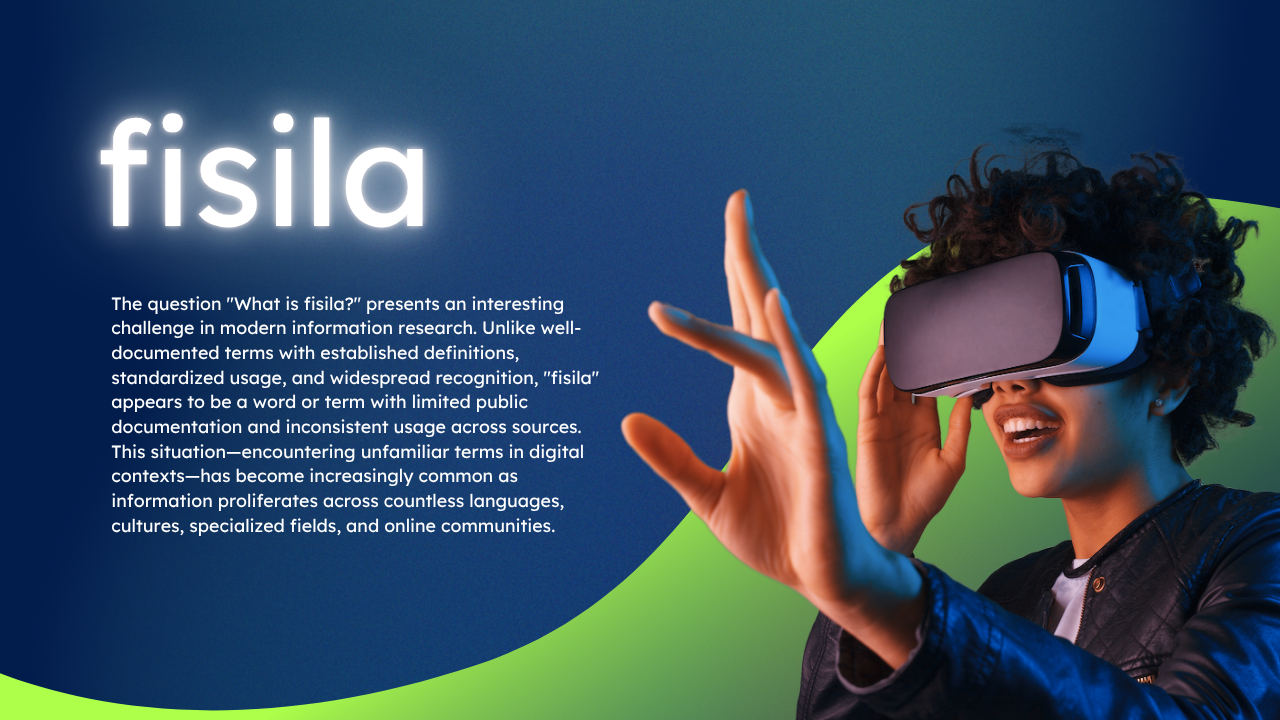
The question “What is fisila?” presents an interesting challenge in modern information research. Unlike well-documented terms with established definitions, standardized usage, and widespread recognition, “fisila” appears to be a word or term with limited public documentation and inconsistent usage across sources. This situation—encountering unfamiliar terms in digital contexts—has become increasingly common as information proliferates across countless languages, cultures, specialized fields, and online communities.
Understanding what “fisila” means requires different approaches than researching well-established terms. Rather than consulting a single authoritative source, investigating “fisila” involves contextual analysis, research methodology, consideration of linguistic origins, and examination of specialized or regional usage. This comprehensive exploration examines what is known about “fisila,” investigates possible meanings and contexts, and provides frameworks for researching unfamiliar terms.
The process of investigating unknown terms like “fisila” illuminates broader principles about how language works, how specialized terminology develops, and how modern information research functions. Whether “fisila” is a regional term, specialized jargon, a word from another language, or something else entirely, exploring its possible meanings and contexts provides valuable insight into terminology research and information investigation methods.
Initial Research Challenges and Approaches
The Problem of Limited Documentation
When researching “fisila,” one quickly encounters a fundamental challenge: the term appears in limited sources with inconsistent or unclear definitions. Standard dictionaries, encyclopedias, and mainstream reference materials generally don’t include entries for “fisila,” suggesting it either:
Lacks widespread recognition: The term may be too specialized, regional, or niche to have achieved mainstream documentation.
Represents recent development: New terms, slang, or specialized language may not yet be included in standard references with lag time between emergence and documentation.
Exists primarily in specific communities: The term might be primarily used within particular cultural groups, professional fields, online communities, or geographic regions.
Represents misspelling or variation: “Fisila” might be a spelling variation, transliteration, or alternate form of another term.
This limited documentation creates genuine difficulty in providing a comprehensive, authoritative definition. However, investigating available information and considering contextual clues can provide understanding of what “fisila” likely represents.
Research Methodology for Unknown Terms
When encountering unfamiliar terms like “fisila,” productive research approaches include:
Search Engine Research: Searching “fisila” on Google, Bing, and other engines to locate any available information. Results may reveal context, usage, or related terms.
Social Media Exploration: Platforms like Twitter, Instagram, Reddit, and others may contain informal discussions using the term, providing clues about meaning and usage.
Specialized Databases: Depending on suspected field (academic, technical, cultural), specialized databases might contain information unavailable in general sources.
Linguistic Analysis: Examining the term’s structure (prefixes, suffixes, letter patterns) for clues about language origin and potential meaning.
Translation Tools: If suspected to be from another language, translation tools or multilingual dictionaries might provide insight.
Community Inquiry: Asking in relevant communities (online forums, social media, specialized groups) where the term is used might yield explanations from people familiar with it.
Contextual Research: Examining where you encountered “fisila” provides crucial context suggesting its meaning or usage.
Possible Origins and Linguistic Considerations
Potential Language Origins
Without clear documentation, “fisila” could originate from various sources:
Romance Languages: The term structure resembles Spanish, Italian, Portuguese, or French construction, suggesting possible origin from these language families.
Finnish or Nordic: The letter combination “fis” could suggest Finnish, Swedish, Norwegian, or Danish origins.
Slavic Languages: The structure could reflect Russian, Polish, Czech, or other Slavic language patterns.
Regional or Dialectal Term: “Fisila” might be a regional dialect word, slang term, or colloquial expression from specific geographic area.
Transliteration: The term might represent transliteration from non-Latin script (Cyrillic, Greek, Arabic, etc.) into Latin characters.
Technical or Specialized Jargon: In specific fields (technology, medicine, science), specialized terms develop that don’t appear in general dictionaries.
Newly Coined Term: Recent developments in culture, technology, or social media might have generated new terms still establishing themselves in usage.
Linguistic Structure Analysis
Examining “fisila” itself provides limited clues:
Character Composition: Six letters, all alphabetic, no numbers or special characters. Standard Latin alphabet composition.
Syllable Structure: Appears to divide as “fi-si-la,” suggesting three syllables common in various languages.
Prefix-Suffix Possibilities: No obvious English prefixes or suffixes, though “-la” ending appears in various Romance languages and other languages.
Sound Patterns: The pattern “fis-” and “-la” end suggests possible Romance language origin, though this is speculative without additional information.
Comparative Analysis
Comparing “fisila” with known terms:
Similar-sounding words: Words like “vanilla,” “gorilla,” “manilla” share the “-illa” ending, though “fisila” ends in “-la” not “-lla.”
Similar structure: Words from various languages share similar structure, but without documented use of “fisila,” determining origin language remains challenging.
Etymology searching: Traditional etymological analysis requires documented historical usage and evolution of the term, which appears unavailable for “fisila.”
Possible Categories and Contexts
Cultural or Traditional Terms
“Fisila” might represent:
Traditional Practice: A cultural tradition, ceremony, or practice from specific culture or region, preserved in original language terminology.
Food or Dish: Possibly a food item or traditional dish from particular cuisine, with “fisila” representing local name for this food.
Cultural Object: Could refer to traditional craft, clothing, decoration, or other cultural artifact with specific name in its culture of origin.
Traditional Knowledge: Might represent traditional concept, practice, or belief system specific to particular cultural group.
Cultural terms often don’t appear in mainstream dictionaries if they’re primarily used by specific communities or in specific geographic regions. Such terms remain important within their communities despite limited mainstream documentation.
Regional or Geographic Terms
“Fisila” could be:
Place Name: A geographic location—city, region, mountain, river, or other geographic feature—known by this name in local language or among local population.
Regional Dialect Word: A word used in specific region with meaning that might not be understood in other areas.
Local Designation: A term used locally to describe something specific to that region without standardized documentation.
Community-Specific Term: A word or concept primarily used within particular community or group, with limited external recognition.
Geographic and regional terms often remain undocumented in mainstream sources, known primarily to people from those regions.
Technical or Specialized Terminology
In specialized fields, “fisila” might be:
Technical Term: Jargon from medicine, law, engineering, science, or other specialized field, used primarily by professionals in that field.
Academic Concept: An academic term used in specific discipline, possibly from languages other than English in international academic contexts.
Professional Jargon: Occupational terminology specific to particular profession or industry.
Emerging Technology Term: New terminology developing in technology fields, possibly still establishing mainstream usage.
Niche Community Terminology: Specialized language within online communities, fandoms, gaming communities, or other niche groups.
Specialized terminology often remains undocumented in general references until it achieves broader adoption across multiple communities.
Online or Slang Terms
“Fisila” could represent:
Internet Slang: Informal language developed in online communities, potentially specific to certain platforms or communities.
Meme or In-Joke: Inside joke or reference within online community, with meaning understood primarily by community members.
Hashtag or Brand: Possibly a hashtag, brand name, or trademarked term used online.
Recent Slang Development: Slang emerges and changes rapidly in online contexts; “fisila” might be recent development not yet widely documented.
Community Language: Language specific to particular online community with unique terminology and usage conventions.
Online and slang terms develop rapidly and may achieve wide usage within communities before being documented in traditional references.
Investigation Strategies and Research Approaches
Contextual Analysis Framework
When researching “fisila,” consider context where you encountered it:
Source Identification: What source contained the term? Website, document, social media, conversation, publication? The source provides crucial context.
Associated Information: What other information appeared with “fisila”? Names, dates, locations, descriptions, or other context clues suggest meaning.
Usage Pattern: How was “fisila” used? As noun, verb, adjective? In what grammatical context? This suggests word category and possible meaning.
Language Context: What language was primary language of source? If non-English source, “fisila” might be word in that language.
Geographic Context: Where did information originate? Geographic origin suggests possible language or cultural context.
Temporal Context: When was information created? Recent information might contain newly developed terminology.
Field or Topic: What field or topic was information about? Suggests possible specialized terminology or context-specific meaning.
Direct Research Methods
Search Engine Queries:
- Search “fisila” directly
- Search “fisila definition”
- Search “fisila meaning”
- Search “fisila word”
- Add context: “fisila [language]” or “fisila [topic]”
Social Media Searches:
- Twitter/X: Search for #fisila or “fisila” in tweets
- Reddit: Search subreddits for “fisila” discussions
- Instagram: Search hashtags and captions
- TikTok: Search for “fisila” content
Specialized Searches:
- Academic databases: Google Scholar, specialized discipline databases
- Language-specific resources: If suspected language origin, search in those languages
- Community forums: Specialized forums in suspected field or community
- Regional websites: Websites from suspected geographic origin
Translation and Multilingual Resources:
- Google Translate: Experiment with translating “fisila” as if it were different languages
- Multilingual dictionaries: Search in dictionaries for other languages
- Language learning platforms: Resources like Duolingo or language-specific communities
Community Inquiry Methods
Targeted Questions:
- Post in relevant communities asking about “fisila”
- Specify context where encountered it
- Ask for any information about meaning or usage
- Request correction if it’s misspelling or variation
Niche Community Searches:
- Reddit communities related to suspected field
- Discord servers or online communities
- Facebook groups
- Specialized forums
- Online communities for suspected language or culture
Expert Consultation:
- Academic experts in suspected field
- Cultural experts from suspected geographic origin
- Language professionals if suspected linguistic term
- Specialists in suspected category (technology, medicine, culinary, etc.)
Common Challenges in Term Research
Misspelling or Variation Issues
“Fisila” might be:
Common Misspelling: Possibly a misspelling of more common term. Without knowing intended term, determining correct spelling is challenging.
Transliteration Variation: Different transliteration systems from non-Latin alphabets might produce variations. The intended term might be spelled differently in other transliteration systems.
Regional Spelling: Different regions or time periods might use different spellings of the same word.
Linguistic Variation: Related languages might have similar words with different spellings reflecting language differences.
Determining whether “fisila” is correct spelling or variation of another term requires additional context or more information.
Language Barrier Challenges
Documentation in Other Languages: The term might be well-documented in its original language but not in English, creating difficulty for English-language researchers.
Translation Issues: Translating terms from other languages sometimes creates misunderstandings or loss of meaning.
Cultural Concepts: Some concepts don’t translate cleanly between languages, making understanding difficult across language boundaries.
Linguistic Expertise Required: Understanding terms from other languages often requires linguistic expertise in those specific languages.
Rapidly Evolving Terminology
Emerging Terms: New terminology develops faster than documentation systems can capture and preserve. “Fisila” might be too new for established references.
Slang and Colloquial Language: Informal language evolves rapidly, particularly in online contexts, making documentation challenging.
Niche Community Language: Specialized communities develop terminology rapidly, sometimes achieving wide use within community before broader documentation.
Documentation Lag: Lag time between term emergence and documentation in standard references means newly popular terms often lack documentation.
Information Literacy and Term Investigation
Developing Research Skills
Researching unfamiliar terms like “fisila” develops valuable information literacy skills:
Multiple Source Consultation: Relying on multiple sources rather than single authoritative source develops critical thinking about information verification.
Contextual Analysis: Learning to extract meaning from context develops analytical skills valuable beyond term research.
Critical Questioning: Asking “What language is this from?” “Where would this be used?” “Who would use this term?” develops critical thinking.
Resource Navigation: Learning to search various resources, interpret results, and combine information develops practical research skills.
Uncertainty Tolerance: Accepting that some questions don’t have definitive answers, understanding limitations of available information, and working with incomplete knowledge are important skills.
Evaluating Information Quality
When researching “fisila,” evaluate information quality:
Source Credibility: Are information sources credible? Do they have expertise in relevant field or language?
Consistency: Do multiple sources agree? Contradictions suggest need for further investigation.
Completeness: Is information complete enough to understand meaning, or are important details missing?
Currency: Is information current? Older information might not reflect current usage if “fisila” is newer term.
Verification: Can information be verified through multiple independent sources?
Bias: Might information be biased? Consider whether sources have particular perspectives or interests affecting information presentation.
FAQ: Frequently Asked Questions About Fisila
What is fisila?
Based on available research, “fisila” appears to be a term with limited mainstream documentation. It could be a regional term, specialized jargon, word from another language, or recently developed terminology. Without additional context, a definitive definition is difficult to provide.
Where did the term fisila come from?
The origin of “fisila” is unclear without additional context. It might be from Romance languages (Spanish, Italian, Portuguese, French), Nordic languages (Finnish, Swedish), Slavic languages, or could be recently developed terminology. Language origin analysis requires more information.
Is fisila an English word?
“Fisila” does not appear in standard English dictionaries, suggesting it is either from another language, a specialized term, a regional dialect word, or a recently developed term not yet included in established references.
What language is fisila from?
Based on linguistic structure, “fisila” might be from Romance languages, Nordic languages, Slavic languages, or other language families. Without definitive evidence, determining language origin requires additional context about where or how the term is used.
How do I find the meaning of fisila?
Recommended approaches include:
- Search Google and other search engines with the term
- Search social media platforms
- Research in specialized databases related to suspected field
- Consult language resources if suspected from other language
- Ask in online communities where the term might be used
- Examine context where you encountered the term for clues
Is fisila a common word?
Based on limited documentation and difficulty locating information, “fisila” does not appear to be a widely recognized common word. It is likely either specialized, regional, or niche terminology.
Could fisila be a misspelling?
It’s possible. If you encountered “fisila” as a misspelling, determining the intended term requires context. Consider what word might sound similar or what context suggests was intended.
Is fisila used in specific communities?
“Fisila” might be terminology specific to particular communities—geographic regions, professional fields, online communities, or cultural groups. Communities often develop specialized language understood primarily by members.
How can I use fisila in a sentence if I don’t know what it means?
Without knowing the meaning, using the term is not recommended. Using unfamiliar terms without understanding them risks miscommunication or misuse. Better to ask for clarification or research further before using the term.
Could fisila be a proper noun?
Possibly. “Fisila” might be a place name, personal name, brand name, or other proper noun. Proper nouns are often not included in general dictionaries, particularly if from non-English languages.
Is fisila related to fishing or fish?
The “fis” beginning might suggest connection to fishing or fish if from English or Germanic languages. However, “fis” could also be coincidental beginning in words from other languages unrelated to fishing.
What if I encountered fisila in another language?
If encountered in another language source, the term might be:
- Word in that language (requiring translation or language-specific dictionary)
- Transliteration of non-Latin script word
- Technical term specific to that language’s field of use
- Regional or cultural term specific to that language community
How can I contribute to documenting fisila?
If you have knowledge about “fisila”:
- Share information in relevant online communities
- Contact academic or professional organizations in relevant fields
- Contribute to specialized wikis or terminology databases
- Document usage and context in online forums
- Help others researching the term by sharing what you know
Where should I look for specialized terminology like fisila?
Specialized terminology appears in:
- Field-specific dictionaries and glossaries
- Academic journals and publications in the field
- Professional organizations’ resources
- Online communities focused on the field
- Social media discussions within the community
- Textbooks and educational materials in the field
Why is fisila difficult to find information about?
Reasons might include:
- Term is regional or community-specific with limited documentation
- Term is recently developed, preceding documentation in standard references
- Term is primarily documented in non-English sources
- Term is specialized jargon known primarily to field practitioners
- Term might be misspelling or transliteration variation of another word
What should I do if I still can’t find information about fisila?
Options include:
- Accept that some terms cannot be definitively researched with available information
- Work with context clues to infer likely meaning
- Ask directly in relevant communities
- Seek expert consultation in suspected field or language
- Document your research process and findings for others researching the same term
Could fisila be slang or internet terminology?
Possibly. Internet slang develops rapidly and might not be documented in traditional references. Researching in social media, online forums, and community-specific spaces might reveal slang meanings.
How do I know if my interpretation of fisila is correct?
Verification approaches include:
- Consulting multiple sources for consistency
- Asking in communities where term is used
- Seeking expert verification
- Testing interpretation against context where encountered
- Revising interpretation if contradicted by additional information
What are related terms to fisila?
Without knowing what “fisila” is, identifying related terms is challenging. Related term research would require more information about field, language, or context where “fisila” is used.
Should I use fisila if I’m unsure of its meaning?
Generally, no. Using terms without understanding them risks miscommunication or inappropriate usage. Better to research further, ask for clarification, or use more familiar terminology until meaning is certain.
Conclusion: Understanding the Challenge of Unknown Terms
The investigation of “fisila” illustrates broader challenges in contemporary information research and the reality that not all terms have readily available definitions. In an era of globalized communication, specialized fields, rapidly developing online communities, and cross-linguistic interaction, encountering unfamiliar terms is increasingly common. Rather than viewing such encounters as failures of reference materials or research methods, they present opportunities to develop information literacy skills and understand how language and terminology function.
“Fisila” remains, based on available research, a term with limited mainstream documentation. It might be a regional term, specialized jargon, word from another language, a recently developed terminology, or something else entirely. The difficulty in determining a definitive meaning illustrates how much of human language and communication occurs outside standardized, documented systems—in communities, regions, specialized fields, and online spaces where people create and use language to meet their specific communicative needs.
For anyone researching “fisila” or encountering similar unfamiliar terms, the most productive approach involves:
Contextual Analysis: Examining carefully where and how the term was encountered
Multiple Research Methods: Using search engines, social media, specialized databases, translation tools, and community inquiry
Information Evaluation: Critically assessing sources and information quality
Expert Consultation: Seeking guidance from people or organizations with relevant expertise
Acceptance of Uncertainty: Recognizing that some terms cannot be definitively researched with available information
Continued Investigation: Remaining open to new information that might clarify meaning
The process of researching unknown terms like “fisila” develops valuable skills applicable far beyond this specific term. Information literacy, critical thinking, contextual analysis, and resourcefulness all develop through engaging with information challenges and unfamiliar terminology.
Should you discover what “fisila” actually means, or should you have additional context about this term, that information would be valuable for others researching the same question. Until then, understanding “fisila” remains work in progress—a reminder that our collective knowledge continuously evolves and expands as we encounter new information and contexts throughout our research and communication endeavors.