Velcro – Quick Info Table
| Detail | Information |
|---|---|
| Name | Velcro |
| Type | Hook & Loop Fastener |
| Company | Velcro Companies |
| Founded | 1958 |
| Inventor | George de Mestral |
| Material | Nylon / Polyester |
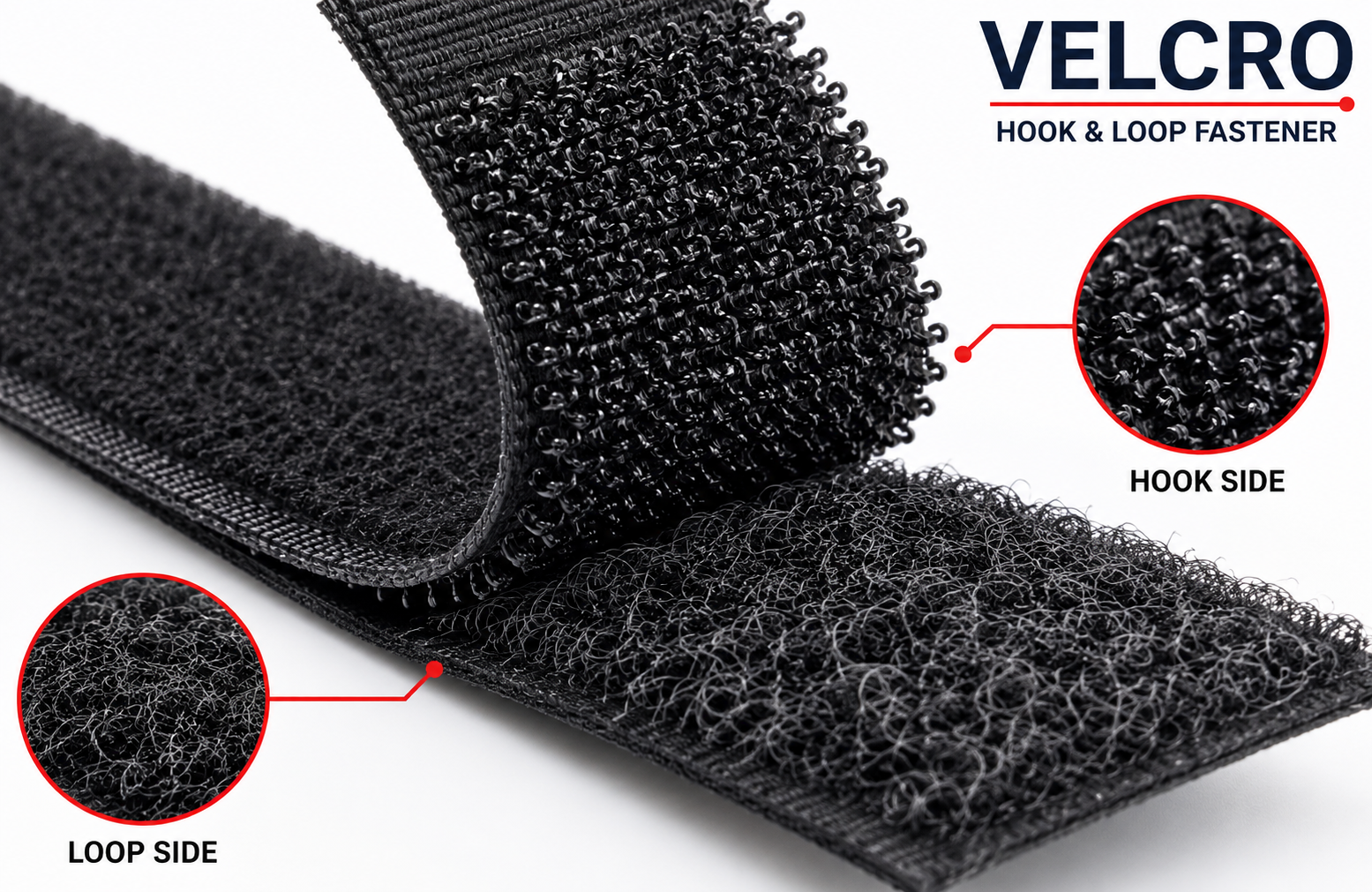
| Hook Side | Rough side with tiny hooks |
| Loop Side | Soft side with fiber loops |
| Main Feature | Reusable fastening system |
| Advantages | Strong grip, easy to open/close, lightweight, durable |
| Applications | Shoes, clothing, bags, medical products, cables, industrial uses |
| Category | Fastening Solution |
What Is Velcro?
Understanding the Basic Concept
Velcro represents one of history’s most elegant technological solutions to a simple problem: how to fasten two objects together in a way that’s quick, easy, adjustable, and reusable. Rather than relying on buttons, zippers, or permanent stitching, Velcro provides a temporary yet durable connection that can be made and broken thousands of times without degradation. The system’s genius lies in its simplicity—two pieces of specially manufactured fabric that, when pressed together, create friction and mechanical interlocking sufficient to hold objects securely.
The beauty of Velcro as a fastening system is that it requires no additional tools, special skills, or complex mechanisms. Unlike zippers that can jam or break, buttons that can fall off, or snaps that can separate unexpectedly, Velcro simply works. Press the two sides together, and they stick. Pull them apart, and they release. This straightforward functionality, combined with durability and reliability, explains why Velcro has become such a pervasive feature of modern life.
Velcro as a Brand vs. Generic Term
It’s important to distinguish between Velcro as a specific brand and hook-and-loop fasteners as a generic category. Velcro is a registered trademark owned by the Velcro Companies, which manufactures and distributes the branded product globally. However, “Velcro” has become so ubiquitous that many people use it colloquially to refer to any hook-and-loop fastener, regardless of manufacturer. This linguistic shift, where a brand name becomes synonymous with a product category, also happened with products like Kleenex (tissue), Band-Aid (adhesive bandage), and Xerox (photocopying).
The generic term for this technology is “hook-and-loop fastener,” which accurately describes the mechanism without reference to any particular brand. Many manufacturers produce hook-and-loop fasteners under various brand names, though Velcro remains the most recognizable and respected name in the industry. Understanding this distinction is important for technical accuracy and when discussing intellectual property and trademark law.
Physical Characteristics and Appearance
Velcro consists of two distinct fabric components, each with a very different texture and appearance. The hook side appears rough and somewhat scratchy, with a slightly metallic quality due to the thousands of tiny stiff fibers standing perpendicular to the backing fabric. When you run your finger across it, the sensation is distinctly harsh and slightly painful if you press too hard.
The loop side, by contrast, feels soft and fuzzy, like felt or certain types of fleece. It has a gentle, almost velvety texture that’s pleasant to touch. These two dramatically different textures are essential to how the system functions. The visual and tactile differences make it immediately obvious which side is which, making Velcro intuitive to use. Most commercial Velcro products color-code the sides as well, typically making the hook side black or dark-colored and the loop side tan or light-colored, though colors vary by manufacturer and application.
The History and Invention of Velcro
George de Mestral and the Burdock Burr Inspiration
The story of Velcro’s invention exemplifies how careful observation of nature can lead to innovative human solutions. In 1941, Swiss engineer George de Mestral took a hunting trip with his dog in the Alps. After the hike, he noticed that burdock burrs—the spiky seed pods of the burdock plant—had become stubbornly attached to his clothes, his socks, and his dog’s fur. Rather than simply removing them in frustration, de Mestral’s curiosity was piqued.
De Mestral examined the burdock burrs under a microscope, a decision that would change history. What he discovered was elegant in its simplicity: the burrs were covered with hundreds of tiny, stiff hooks that naturally caught on the looped fibers of fabric and animal hair. This observation planted the seed for an idea—could he artificially create a fastening system based on this natural mechanism? The question became the genesis of Velcro.
Development and Challenges
While the concept seemed straightforward, transforming it into a practical, manufacturable product proved challenging. De Mestral spent nearly a decade in development, working to find materials and manufacturing processes that could create the necessary hook and loop structures reliably and at scale. The technical challenges were substantial: creating hooks small enough to be comfortable to wear but rigid enough to hold firmly, and creating loops dense enough to catch the hooks without being so tight that they couldn’t be separated.
The development process required collaboration with textile manufacturers and engineers who could help translate de Mestral’s vision into reality. Various materials and manufacturing techniques were tested. De Mestral eventually developed a process using nylon, which proved ideal for creating both the rigid hooks and the soft loops. The manufacturing process required precision and specialized equipment, but once perfected, it could be applied consistently across large production runs.
Patent and Trademark Success
De Mestral patented his invention in 1951, receiving U.S. Patent 2,717,437 for his “hook-and-loop fastening device.” This patent protection was crucial in allowing him to commercialize his invention and profit from it. The patent described the technical mechanism and manufacturing process, establishing legal protection that would last for decades. De Mestral’s foresight in securing patent protection ensured that his investment in development would be protected.
The trademark “Velcro,” created by combining the French words “velours” (velvet) and “crochet” (hook), was particularly successful as a brand name. The name is euphonious, memorable, and accurately describes what the product does. When Velcro was introduced to the market, it quickly became associated with quality and reliability, establishing a brand reputation that persists today. De Mestral’s combination of technical innovation, patent protection, and effective branding created a business success story that continues more than eighty years later.
How Velcro Works: The Technical Mechanism
The Hook Component
The hook side of Velcro consists of thousands of tiny, stiff fibers standing perpendicular to a fabric backing. These fibers are typically made from nylon or similar synthetic materials that provide the necessary rigidity. The fibers are cut to a precise length and thickness, usually less than a millimeter tall but thick enough to maintain their rigidity when pressed and released repeatedly.
The key to the hook side’s functionality is the rigidity of these fibers. Unlike the flexible loops on the other side, the hooks remain relatively stiff, allowing them to push through the loops and catch them. The spacing and density of the hooks is carefully calibrated to maximize holding power while keeping the hooks small enough that they’re comfortable to wear against skin. Too many hooks would make the material scratchy and uncomfortable; too few would reduce holding power. Manufacturers have spent decades perfecting the optimal balance.
The hook fibers are anchored securely to the backing fabric, which is typically woven nylon or polyester. This backing provides structural integrity and ensures that the hooks remain attached even through thousands of cycles of pressing and releasing. The backing also prevents the hooks from pulling through fabric when pressure is applied, a critical engineering consideration for reliability.
The Loop Component
The loop side consists of a dense network of tiny, soft loops made from the same or similar nylon material as the hook side. However, rather than standing stiffly upright, these loops lie relatively flat or wave slightly, creating a fuzzy, soft texture. The loops are typically created through a process of brushing or flocking the fabric surface, raising fibers that then form the characteristic loop structure.
The loops must be dense enough to catch the hooks but soft enough to be flexible and comfortable. When hooks press into the loops, the loops bend and wrap around them, creating the mechanical interlocking that holds the two sides together. The softness of the loops is essential—if they were rigid, they would resist interlocking with the hooks, and the fastener wouldn’t hold effectively. The fuzzy texture results from the loops’ flexibility and the way they interact with light.
The backing of the loop side, like the hook side, must be strong and durable to withstand thousands of cycles of use. The backing also prevents the loops from pulling out when the hook side is pressed and removed repeatedly. The engineering of this backing is less visible than the visible loops, but it’s equally important to the system’s functionality and durability.
The Interlocking Mechanism
When the hook and loop sides are pressed together, the rigid hooks push through the network of soft loops. As pressure is applied, the hooks compress the loops and force their way deeper into the fuzzy surface. The flexible loops then wrap around the hooks, creating multiple contact points between the two surfaces.
The holding power of this mechanical interlocking comes from friction and the difficulty of separating the hooks from the loops. Once the hooks are embedded in the loop surface, removing them requires significant force to overcome the friction and work the hooks back out. The more contact points between hooks and loops, the greater the holding force required to separate them.
This mechanical interlocking is purely physical—there’s no adhesive, no chemical bonding, and no permanent changes to either surface. This is why Velcro can be used thousands of times. Each time the hook and loop sides are separated, the hooks straighten back up to their original position, and the loops return to their fuzzy structure. Neither surface is damaged or degraded in the process, allowing the cycle to repeat indefinitely (or at least until the materials wear out from excessive use).
The Separation Process
When you pull the hook and loop sides apart, the distinctive ripping or tearing sound you hear results from the hooks being forcibly removed from the loops. This sound is caused by multiple hooks breaking free simultaneously, each one working its way back out through the fuzzy loop structure. The sound is distinctive enough that most people immediately recognize it, and it’s become iconic as the signature of Velcro operation.
The force required to separate hook and loop depends on several factors: the density of the hooks, the density of the loops, the size of the contact area, and the quality of the manufacturing. High-quality Velcro holds more strongly than lower-quality versions because the hooks and loops are manufactured to tighter specifications, creating better interlocking. This explains why some Velcro products hold better than others—manufacturing precision directly affects performance.
The separation process is gentle on both sides because the hooks are designed to straighten without tearing, and the loops are designed to withstand being worked through without pulling out. This engineered durability is why Velcro can be used repeatedly without degradation. Each separation operation is similar to the previous one, with the hook and loop surfaces returning to their original configuration ready for the next use.
Products, Formats, and Applications
Sew-On Strips
One of the original formats for Velcro and still widely used, sew-on strips are non-adhesive tape designed to be machine-stitched or hand-stitched directly onto fabric, clothing, footwear, and textile luggage. The hook-and-loop material is already attached to a fabric backing that accommodates sewing, with pre-punched holes or edges designed to be easy to stitch.
Sew-on Velcro is preferred for applications where permanence is desired and the fastener will experience significant stress. Because it’s sewn directly into the fabric, sew-on Velcro won’t gradually peel away as adhesive-backed versions might. This makes it ideal for baby clothes, children’s clothing, and items that will be washed frequently. The sewn attachment is particularly strong and durable, often outlasting the surrounding fabric.
The main disadvantage of sew-on Velcro is that it requires sewing, which many people don’t have skills for or equipment to perform. Sewing also takes time, making it impractical for quick repairs or temporary applications. However, for permanent attachment and high-stress applications, sew-on Velcro remains the gold standard of durability.
Adhesive-Backed or Sticky-Back Tape
The introduction of pressure-sensitive adhesive-backed Velcro revolutionized its applications and made it accessible to the general public. Sticky-back Velcro features a peel-and-stick backing that uses pressure-sensitive adhesive to bond directly to smooth surfaces like walls, glass, metal, plastic, and wood. This format requires no sewing, no tools, and no special skills—simply peel the backing and press the material onto the desired surface.
Adhesive-backed Velcro adheres well to most smooth, clean surfaces and holds reasonably well in many applications. For lightweight items and temporary applications, it performs admirably. Many people use adhesive-backed Velcro for wall-mounted organizers, cable management, holding photos or posters, and securing lightweight items in vehicles or RVs.
The main limitations of adhesive-backed Velcro are that the adhesive can gradually fail, particularly in humid or hot environments, and the tape can eventually peel away from surfaces. Additionally, when removing adhesive-backed Velcro, it can sometimes leave residue on the surface. However, for convenience and ease of use, adhesive-backed Velcro is hard to beat, which explains its widespread popularity in consumer applications.
Pre-cut Dots and Coins
Manufacturers also produce pre-cut dots or coins of Velcro, small circular pads typically ranging from a quarter-inch to an inch in diameter. These pre-cut pieces are available in both adhesive-backed and sew-on formats. The pre-cut format is particularly popular in arts and crafts, office organization, and applications where small fastening points are needed rather than long strips.
The convenience of pre-cut dots is significant—they’re ready to use without cutting, and they come in various sizes to match different application needs. Many people use them for office organization, hanging lightweight items, fastening craft projects together, and countless other small-scale applications. The dots are available from multiple manufacturers and are among the least expensive hook-and-loop fastener options.
Pre-cut dots are less durable than strips for applications requiring very strong holds, but for typical light-duty applications, they work well. Their main advantage is convenience and the ease of creating custom fastening layouts without needing to measure and cut material.
Industrial and Specialty Formats
Beyond the consumer formats, industrial manufacturers produce hook-and-loop fasteners in countless specialized formats. Double-sided tape (both sides being hook or both being loop) is used for creating custom fastening arrangements. Heavy-duty formats are designed for demanding applications where maximum holding power is needed. Fabric-integrated formats blend hook-and-loop material directly into textiles during manufacturing.
Specialty applications include adhesive formulations designed for specific surfaces like outdoor use with resistance to UV degradation and temperature extremes, formats designed for use in wet environments, and configurations optimized for particular industries. The aerospace industry uses Velcro extensively, with specialized high-temperature and high-performance versions engineered for aircraft interiors. Medical devices, military equipment, and industrial machinery all employ Velcro in specialized configurations designed for their specific requirements.
Common Uses and Applications
Clothing and Footwear
Velcro’s use in clothing and footwear represents one of its most visible applications. Children’s clothing frequently features Velcro closures, which are easier for children to use than buttons, zippers, or snaps. Athletic shoes, particularly children’s shoes and some adult sports shoes, use Velcro straps as adjustable closures. Many people find Velcro easier to use than laces, particularly those with limited dexterity or mobility.
The comfort and convenience of Velcro in footwear have made it a staple feature. Unlike laces that come untied, Velcro adjustably holds shoes securely while remaining easy to open. For people with arthritis, limited hand strength, or mobility limitations, Velcro shoes provide independence in a way that laced shoes don’t. This accessibility dimension gives Velcro social significance beyond mere convenience.
Adaptive clothing designed for people with disabilities frequently incorporates Velcro, allowing individuals who cannot manage traditional fasteners to dress independently. This application highlights how a simple technology can have profound impacts on people’s lives by enabling independence and dignity. Many hospitals and care facilities also use Velcro in patient gowns and other clothing for similar accessibility reasons.
Bags and Luggage
Velcro closures appear on countless bags, backpacks, and luggage pieces. The adjustability of Velcro closures makes them particularly useful for bags that need to accommodate varying contents and volumes. Sports bags, travel bags, and cargo bags often feature Velcro straps and closures that allow users to customize the fit and security.
The durability of Velcro makes it suitable for luggage, where fasteners experience significant stress. Sew-on Velcro is frequently used in luggage manufacturing because it can withstand years of use while remaining reliable. The ability to adjust Velcro closures based on how full a bag is provides practical advantages over fixed fasteners like zippers.
Electronics and Cable Management
Velcro is extensively used in electronics for cable management and organization. Cable ties made from Velcro allow users to bundle and organize cords without permanently securing them. The reusability of Velcro cable ties is a significant advantage—they can be adjusted and reused as equipment is rearranged or updated. Many computer systems, home theater setups, and other complex electronic installations employ Velcro for cable management.
The non-destructive nature of Velcro is particularly valuable in electronics applications. Unlike zip ties that must be cut to be removed, Velcro can be adjusted and reused indefinitely. This reusability reduces waste and saves money over time, particularly in installations with frequently changing equipment configurations.
Office and Home Organization
Velcro appears throughout offices and homes in various organizational applications. Adhesive-backed Velcro holds photos, documents, and organizers to walls without permanent damage. Cable management systems use Velcro to bundle and organize cables. Storage solutions employ Velcro to attach bins and organizers to walls or shelves.
The advantage of Velcro in these applications is that it allows temporary organization without permanent changes to spaces. Renters particularly appreciate Velcro because it can be removed without damaging walls. Unlike nails or screws, adhesive-backed Velcro leaves minimal damage and can often be removed without leaving marks.
Automotive and Transportation
Velcro is used extensively in automotive applications, both in vehicle interiors and for securing items within vehicles. Dashboard organizers, phone holders, and cargo systems frequently use Velcro. Many vehicles have Velcro attachments for securing documents, maps, and other items while driving.
In commercial transportation and fleet vehicles, Velcro is used to organize equipment and supplies in ways that can be easily adjusted as needs change. Emergency vehicles, delivery trucks, and service vehicles often use Velcro extensively for organizing tools and equipment while allowing flexibility for different job requirements.
Medical and Healthcare Applications
Healthcare facilities use Velcro extensively in patient care and adaptive equipment. Wound care products, orthopedic braces, and medical devices frequently incorporate Velcro for easy adjustment and secure holding. Adaptive devices for people with disabilities often use Velcro because it’s easier to use than traditional fasteners.
The sterile versions of Velcro are designed to meet healthcare standards for cleanliness and safety. Medical-grade Velcro can be easily cleaned and sterilized, making it suitable for clinical environments. The ability to quickly adjust medical devices using Velcro is valuable in healthcare settings where precision fit and quick adjustments are important.
Industrial and Commercial Uses
Beyond consumer applications, Velcro is used extensively in industrial settings. Heavy-duty formats are employed in manufacturing, where equipment needs to be quickly configured and reconfigured. Mining, construction, and other industries use Velcro for securing equipment and tools.
The durability of industrial-grade Velcro makes it suitable for harsh environments. Specialized formulations are designed to withstand temperature extremes, chemical exposure, and mechanical stress. The reusability of Velcro in industrial applications reduces downtime for equipment adjustments and saves money on fastener replacement.
Arts and Crafts
In the arts and crafts world, Velcro is appreciated for its versatility and ease of use. Pre-cut dots and small pieces are popular for craft projects, allowing creators to attach materials temporarily or removably. Fabric crafts frequently incorporate Velcro for closures and attachments that users might want to adjust.
The ease of working with Velcro makes it accessible to crafters of all skill levels. No special tools or techniques are required—simply cut or position the pieces and adhere or sew them in place. This accessibility has made Velcro a staple in craft rooms and educational settings.
Manufacturing and Quality Considerations
Manufacturing Process
Modern Velcro manufacturing involves sophisticated processes designed to create consistent, high-quality products. The hook side is created by embossing or extruding loops into nylon material and then cutting them at precise heights to create the characteristic hooks. This process requires precision equipment that can control loop height, density, and spacing to tolerances measured in fractions of millimeters.
The loop side is typically created through brushing or flocking processes that raise fibers from the backing material. The intensity and duration of brushing determines the density and height of the loops, both critical factors in holding power. Quality manufacturers carefully control this process to create consistent loop structures.
The adhesive used in sticky-back Velcro is a pressure-sensitive acrylic or rubber-based formulation designed to bond to various surfaces while remaining removable. The adhesive is applied in a thin, even layer to ensure consistent bonding across the entire surface. Different adhesive formulations are used for different applications—permanent formulations for industrial use, removable formulations for temporary applications, and specialized formulations for specific surface types or environmental conditions.
Quality Variations
Not all Velcro products are created equal. The branded Velcro Companies products are generally considered high-quality with excellent holding power and durability. However, numerous manufacturers produce hook-and-loop fasteners under various brand names, and quality varies significantly. Lower-quality products might use thinner backing materials, lower hook or loop density, or lower-quality adhesive formulations.
The difference in quality is often apparent in holding power and durability. High-quality Velcro maintains its functionality for thousands of cycles, while lower-quality versions might lose holding power after a few hundred uses. The differences can also be apparent in comfort—higher-quality hook material feels less harsh against skin than lower-quality versions.
Cost differences between quality levels can be substantial. Premium Velcro products might cost two to three times more than budget options, but they often last significantly longer and perform better. For applications where reliability is important, investing in higher-quality products typically proves more economical than repeatedly replacing lower-quality versions.
Testing and Standards
Quality Velcro products are tested for holding power, durability through repeated use cycles, adhesive strength, and other performance characteristics. Industry standards specify testing procedures to allow comparison between products. The holding power of Velcro is typically measured by applying a known weight to a fastened piece and measuring how much force is required to separate the pieces.
Durability testing involves repeated cycles of pressing together and pulling apart to simulate realistic use over time. Products are tested for changes in holding power after hundreds or thousands of cycles to determine how long they remain effective. Environmental testing examines how Velcro performs in various temperature and humidity conditions, as these factors can affect both the hook-and-loop material and the adhesive in sticky-back versions.
Manufacturers that maintain quality control and test their products provide greater assurance of reliability. This is one reason why branded Velcro from the Velcro Companies commands a price premium—their quality control and testing standards provide assurance of performance.
Advantages and Disadvantages of Velcro
Advantages
The fundamental advantages of Velcro compared to other fastening systems are simplicity, reusability, and adjustability. Unlike zippers that can jam, break, or require alignment, Velcro is simple to use and reliable. Unlike buttons that can fall off or break, Velcro doesn’t have small components that can be lost. Unlike snaps that can separate unexpectedly, Velcro’s grip is strong and reliable.
The reusability of Velcro is perhaps its greatest advantage. While buttons must be replaced if they break and snaps eventually wear out, Velcro can be used thousands of times without degradation. This reusability makes Velcro economical for applications where fasteners are frequently adjusted. The adjustability of Velcro also provides flexibility that fixed fasteners don’t—the same piece of Velcro can securely hold items of different thicknesses or sizes.
For people with limited mobility or dexterity, Velcro provides accessibility that other fasteners don’t offer. Opening or closing Velcro requires minimal fine motor control compared to handling buttons, zippers, or snaps. This accessibility dimension makes Velcro particularly valuable in adaptive clothing and medical devices.
Disadvantages
The primary disadvantages of Velcro relate to holding power limitations and durability in extreme conditions. While Velcro holds adequately for most applications, it doesn’t match the holding strength of some alternative fasteners. Heavy items or applications with significant stress might require stronger fastening methods. Adhesive-backed Velcro in particular can gradually weaken or fail, particularly in humid or hot environments.
The distinctive sound of Velcro separating, while charming and functional as a cue, can be problematic in quiet environments. The sound is loud enough to be disruptive in libraries, classrooms, or other spaces where silence is valued. This limitation has led to some restrictions on Velcro use in schools and other quiet facilities.
Velcro can also be problematic for fuzzy fabrics and fur. Pet owners know that Velcro hooks readily catch pet fur and can be difficult to remove. Similarly, the hooks can snag fuzzy fabrics, potentially damaging them. This limitation restricts Velcro’s use on certain materials and with certain animals.
The visible hooks and loops can also be aesthetically unappealing in some contexts. While manufacturers have worked to create more subtle versions, most Velcro remains quite visible. In applications where aesthetics are important, more discrete fastening methods might be preferable.
Environmental and Sustainability Considerations
Material Composition and Recyclability
Velcro is made from nylon or polyester, synthetic materials derived from petroleum. As petrochemical products, these materials have environmental implications related to extraction, processing, and eventual disposal. However, the durability and reusability of Velcro provides environmental advantages compared to fasteners that require frequent replacement.
The environmental impact of Velcro depends partly on how long it’s used and how many times it’s reused. Because Velcro can be used thousands of times, it has a lower environmental footprint per use than single-use fasteners. A piece of Velcro used a thousand times has one-thousandth the environmental impact per use compared to a fastener used only once.
Recycling of Velcro is possible but not widely practiced. Most communities don’t have established recycling programs for hook-and-loop fasteners. However, as sustainability concerns increase, manufacturers and recyclers are beginning to develop processes for recovering and reusing Velcro material. Some manufacturers are exploring bio-based alternatives to petroleum-derived nylon, though these remain largely experimental.
Sustainable Alternatives and Innovations
Manufacturers are exploring various alternatives to traditional Velcro that might have lower environmental impacts. Bio-based nylon alternatives are being developed to replace petroleum-derived nylon. Mushroom-leather and other novel materials are being tested as eco-friendly alternatives to synthetic fabrics.
The durability and reusability of Velcro already provides significant environmental advantages compared to many alternatives. The push is toward making the existing technology more sustainable by using renewable materials while maintaining performance characteristics. Additionally, manufacturers are exploring ways to make Velcro more easily recyclable, potentially creating closed-loop systems where old Velcro is recovered and reformed into new products.
Consumer interest in sustainable fastening options has encouraged innovation in this space. As companies face pressure to reduce environmental impact, they’re investing in research into more sustainable Velcro alternatives. The long-term trajectory appears to be toward solutions that maintain Velcro’s advantages while reducing environmental impact.
Intellectual Property and Trademark Considerations
The Velcro Trademark
Velcro is a registered trademark protected in numerous countries worldwide. The Velcro Companies actively defends this trademark against dilution and unauthorized use. This legal protection ensures that Velcro remains associated with quality and reliability, as trademark law requires consistent quality standards for branded products.
However, the widespread use of “Velcro” as a generic term for any hook-and-loop fastener poses a challenge to trademark protection. In trademark law, if a brand name becomes the common, generic term for a product category, the trademark can be invalidated. This happened with brands like Escalator, Thermos, and Yo-Yo, which were originally trademarked but lost that protection as the brand names became generic terms.
The Velcro Companies has taken active steps to prevent this “genericide” of their trademark. They actively police unauthorized uses, educate consumers about the distinction between Velcro and generic hook-and-loop fasteners, and emphasize their brand in communications. These efforts have been largely successful in maintaining Velcro’s trademark status while acknowledging that the term is sometimes used generically.
Patent Landscape
The original patent for hook-and-loop fasteners, issued to George de Mestral in 1951, expired decades ago, allowing other manufacturers to create hook-and-loop fasteners without patent infringement. However, the field of hook-and-loop fasteners has seen extensive patent activity as manufacturers develop improvements and variations on the basic concept.
Patents exist for various improvements and variations, including specialized adhesive formulations, manufacturing techniques that improve performance, methods for creating stronger hooks or loops, and applications of Velcro to novel uses. The patent landscape in hook-and-loop fasteners is complex, with numerous patents held by different manufacturers covering different aspects of the technology.
Frequently Asked Questions About Velcro
Who Invented Velcro and When?
Velcro was invented in 1941 by George de Mestral, a Swiss engineer. He was inspired by burdock burrs that stuck to his clothes and dog’s fur during a hiking trip. De Mestral examined the burrs under a microscope, discovered their tiny hooks, and developed an artificial fastening system based on this natural mechanism. He received a U.S. patent in 1951 and commercialized the product under the trademark “Velcro.”
Is Velcro a Brand or a Product Type?
Velcro is a registered trademark owned by the Velcro Companies. It refers to their branded hook-and-loop fastener products. However, “Velcro” is commonly used generically to refer to any hook-and-loop fastener, regardless of manufacturer. The generic term for this technology is “hook-and-loop fastener.” Many manufacturers produce competing products under different brand names.
How Long Does Velcro Last?
High-quality Velcro can be used thousands of times before losing effectiveness. The lifespan depends on the quality of the product, the intensity of use, and environmental conditions. Sew-on Velcro generally lasts longer than adhesive-backed versions because it’s not subject to adhesive failure. Adhesive-backed Velcro might start to fail after hundreds of uses or when exposed to heat, humidity, or certain surface types.
Can Velcro Be Washed?
Sew-on Velcro can typically be washed and dried like regular fabric, maintaining its functionality through many wash cycles. Machine washing might gradually reduce holding power over time due to agitation, but quality sew-on Velcro typically maintains adequate holding power through many washes. Adhesive-backed Velcro should not be washed, as the adhesive can fail when exposed to water and heat.
What’s the Difference Between Sew-On and Adhesive Velcro?
Sew-on Velcro is stitched directly onto fabric for permanent, durable attachment suitable for applications requiring long-term reliability. Adhesive-backed Velcro uses pressure-sensitive adhesive for quick, convenient attachment to smooth surfaces without sewing. Sew-on is more durable and washable; adhesive-backed is more convenient for temporary applications. The choice depends on the specific application and longevity requirements.
Is Velcro Waterproof?
Standard Velcro is not fully waterproof, though the hook-and-loop material itself can withstand limited water exposure. Adhesive-backed Velcro is particularly vulnerable to water because water can weaken the pressure-sensitive adhesive. Specialty waterproof Velcro products are available for marine and outdoor applications, designed to withstand extended water exposure and maintain holding power when wet.
How Do I Remove Adhesive Velcro Without Damaging Surfaces?
To minimize damage when removing adhesive-backed Velcro, pull slowly at a shallow angle rather than straight up, which can tear or damage paint or finishes. Warming the adhesive slightly with a hair dryer can help soften it and make removal easier. If residue remains, rubbing alcohol or adhesive remover products can help clean it off. Test any removal method on an inconspicuous area first.
Can Velcro Be Used on All Surfaces?
Adhesive-backed Velcro adheres best to smooth, clean surfaces like glass, metal, plastic, and sealed wood. It doesn’t stick well to rough, porous, or dusty surfaces, or to textured fabrics or wallpaper. For such surfaces, sew-on Velcro is a better choice. Some manufacturers produce specialty adhesive formulations designed for specific surface types.
How Do I Increase Velcro Holding Power?
To maximize holding power, ensure both surfaces are clean and dry before application. For adhesive-backed Velcro, press firmly for extended time to maximize adhesive contact. For sew-on Velcro, ensure stitching is secure and properly distributed across the entire backing. Using larger contact areas—bigger pieces of Velcro—increases total holding power. Replacing worn Velcro with new material restores holding power.
Is Velcro Safe for Baby Clothes?
Velcro is commonly used in baby clothes as a closure system. The hook side can be somewhat rough, but sew-on Velcro used in clothing is designed to be safe for skin contact. However, parents should ensure that Velcro is securely attached and doesn’t pose a choking hazard if it becomes detached. Adhesive-backed Velcro should not be used on baby clothing.
Why Does Velcro Stop Sticking?
Velcro loses holding power through several mechanisms: adhesive failure in sticky-back versions due to age, heat, or humidity; wearing away of the fuzzy loop material through repeated use; contamination of the loop side with dust, lint, or pet hair; and deterioration of the backing material. Replacing worn Velcro typically restores full holding power.
Can Old Velcro Be Restored?
The holding power of worn Velcro can sometimes be partially restored by brushing the worn loop side with a stiff brush or even Velcro itself, raising some flattened loops. However, this restoration is temporary and partial. For better results, the old Velcro should be removed and replaced with new material. Some people use lint rollers on worn hook material to remove accumulated fibers and restore some holding power.
What Are Common Velcro Alternatives?
Common alternatives to Velcro include zippers, buttons, snaps, magnetic closures, and cord ties. Each has advantages and disadvantages depending on the specific application. For reusable, adjustable fastening, Velcro often remains superior. For permanent connections or applications requiring maximum holding strength, other fasteners might be preferable.
Getting the Most from Velcro
Proper Application Techniques
For adhesive-backed Velcro to adhere effectively, the surface must be clean and dry. Wipe the surface with a cloth to remove dust, and for best results, clean with a mild solvent like rubbing alcohol. Allow the surface to dry completely before applying Velcro. Press firmly on the Velcro for at least thirty seconds to maximize adhesive contact. Allow the adhesive to cure for twenty-four hours before using the Velcro to its full strength.
For sew-on Velcro, proper stitching technique is crucial. Use appropriate thread color and small, tight stitches to secure the backing thoroughly. Distribute stitching across the entire backing rather than just around the edges. This ensures even weight distribution and prevents peeling if the fastener experiences stress. Sew-on Velcro is best installed through a sewing machine, which provides consistent tension and stitch quality.
Maintenance Tips
To extend Velcro lifespan, keep it clean. Lint and dust accumulation on the hook side reduces holding power. Periodically brush the hook side with a stiff brush or even another piece of Velcro to remove accumulated fibers. Similarly, lint rollers can be used to clean hooks when other cleaning methods aren’t appropriate.
For garments and frequently used items with Velcro, washing techniques can extend lifespan. Turn garments inside-out before washing to protect the Velcro. Wash in cold water on gentle cycles rather than hot water and aggressive agitation. Air-dry rather than machine-drying, as heat can degrade the material. These practices, while not required for all uses, can significantly extend Velcro’s lifespan in items subject to frequent laundering.
Problem-Solving
If Velcro isn’t holding adequately, first determine whether the hook side or loop side is the problem. Worn loop material can sometimes be revived by brushing, though this is temporary. If one side is damaged, replacing just that side is often possible, though this requires removing the old Velcro and applying new pieces.
If adhesive-backed Velcro is peeling away, ensure the surface is truly clean and dry. Sometimes cleaning the surface more thoroughly and reapplying with fresh Velcro solves the problem. If the issue persists, sew-on Velcro might be a better solution, or using multiple pieces rather than one large piece distributes stress and improves holding power.
Conclusion
Velcro represents a remarkable example of how careful observation of nature can lead to innovative human solutions. George de Mestral’s insight into how burdock burrs stick to fabric and fur led to a fastening system that has become ubiquitous in modern life. More than eighty years after its invention, Velcro remains relevant and valuable, with applications spanning from children’s clothing to aerospace engineering.
The simplicity of Velcro’s mechanism—tiny hooks interlocking with fuzzy loops—belies the sophistication of manufacturing and engineering required to create reliable, durable products. The distinction between the branded Velcro products and generic hook-and-loop fasteners reflects intellectual property law and quality standards that protect consumers and incentivize manufacturers to maintain high quality.
Understanding how Velcro works, its history, its applications, and its advantages and limitations helps users appreciate this remarkable technology and use it effectively. Whether you’re using Velcro for everyday applications like securing footwear or cable management, or in professional or industrial contexts requiring specialized products, Velcro provides a dependable, reusable, and versatile fastening solution. As manufacturers continue to innovate and develop sustainable alternatives, Velcro’s role in modern life seems likely to endure for decades to come.