Introduction: Understanding Kotora Melnkalne and Its Context
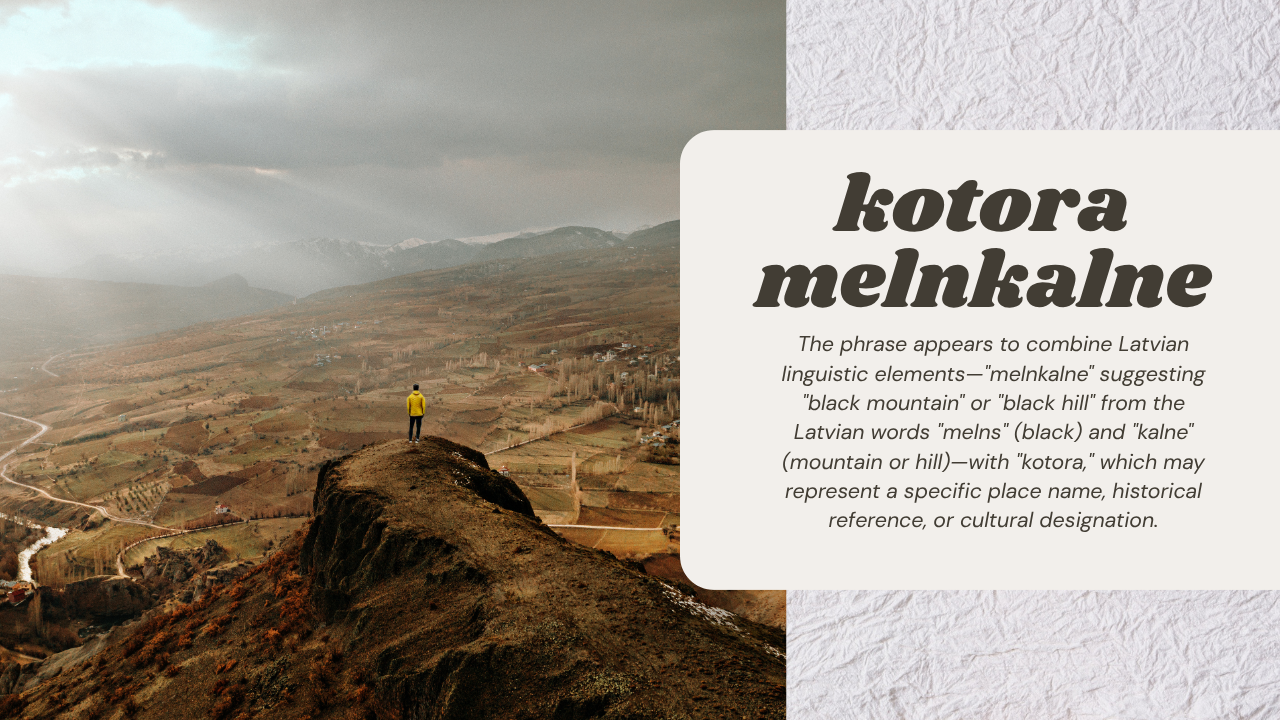
Kotora Melnkalne represents a term that carries significance within Latvian language, culture, and geography. While unfamiliar to those outside Baltic regions or without Latvian language knowledge, this term holds meaning for understanding Latvian heritage, historical geography, and cultural identity. The phrase appears to combine Latvian linguistic elements—”melnkalne” suggesting “black mountain” or “black hill” from the Latvian words “melns” (black) and “kalne” (mountain or hill)—with “kotora,” which may represent a specific place name, historical reference, or cultural designation.
Understanding Kotora Melnkalne requires exploring Latvian language structure, Baltic geography, and the historical and cultural contexts in which such terms emerge. Latvia, situated in the Baltic region of Northern Europe, possesses a rich cultural heritage reflected in its language, place names, historical narratives, and contemporary identity. Place names throughout Latvia often encode historical information, cultural meanings, and geographical characteristics, making their study valuable for understanding regional history and identity.
This comprehensive exploration examines what Kotora Melnkalne might represent, how it connects to broader Latvian cultural and historical contexts, and why understanding such terms contributes to appreciating Baltic heritage and identity. Whether representing a specific location, a historical phenomenon, or a cultural concept, Kotora Melnkalne exemplifies how language preserves and transmits cultural knowledge across generations.
The Latvian Language and Linguistic Context
Understanding the Latvian Language
Latvian belongs to the Baltic language family, representing one of only two surviving Baltic languages (Lithuanian being the other). This linguistic classification places Latvian in a unique position within European languages, as Baltic languages represent an ancient linguistic branch with roots extending thousands of years into European prehistory. The Baltic languages preserve archaic features lost in many other Indo-European languages, making them valuable for linguistic and historical research.
Latvian developed as the primary language of Latvia, a nation in the Baltic region of Northern Europe. The language reflects Latvia’s complex history, featuring vocabulary and grammatical structures influenced by centuries of contact with Germanic, Slavic, and other languages. Despite these influences, Latvian maintains its fundamental Baltic character and serves as a powerful symbol of Latvian national identity and cultural continuity.
The structure of Latvian allows for the formation of compound words and place names through combining meaningful elements. Understanding Latvian terminology requires recognizing how words combine to create meaning and how linguistic patterns encode cultural and geographical information.
Analyzing “Melnkalne”
Breaking down the term “melnkalne” reveals its linguistic components. “Melns” is the Latvian word for “black,” a color that holds various cultural and symbolic meanings. In place names and geographical terminology, color references often describe visible landscape characteristics—dark soil, dark forests, dark rock formations, or other visual features that distinguish locations.
“Kalne” translates to “mountain” or “hill” in Latvian. In Latvian geography, where dramatic mountainous terrain is less common than in other parts of Europe, “kalne” might reference more modest elevations, ridge formations, or elevated areas. The Latvian landscape consists primarily of plains, with some areas featuring low hills and elevated terrain, but nothing comparable to major mountain ranges found elsewhere in Europe.
Combined, “melnkalne” would literally translate as “black mountain” or “black hill,” suggesting a geographical feature characterized by dark coloring. This could refer to dark soil composition, dark rock formations, dark forest coverage, or other characteristics that make a particular elevated area visually or geologically distinct.
The Complete Term: “Kotora Melnkalne”
The first element, “kotora,” presents more interpretive challenge without additional context. “Kotora” could represent a place name, a historical district, a family name, or a cultural designation. In Latvian naming conventions, such terms often have specific historical or geographical origins worth investigating. Understanding the complete term “Kotora Melnkalne” likely requires knowledge of Latvian regional history, local place name traditions, or specific cultural contexts.
Latvian Geography and Place Names
Place Naming Traditions in Latvia
Latvian geography is richly documented through place names that encode historical information, geographical characteristics, cultural meanings, and sometimes linguistic artifacts from various historical periods. Studying Latvian place names provides insight into settlement patterns, historical events, geographical features, and the linguistic layers that comprise Latvian cultural heritage.
Many Latvian place names follow patterns similar to those found in other Baltic and Northern European languages. Geographic features—forests, rivers, hills, valleys—frequently appear in place names. Human activities and structures—settlements, fortifications, religious institutions—also generate place names. Historical events, legendary figures, and cultural practices sometimes provide origins for specific locations’ names.
The prevalence of nature-based place names reflects Latvia’s historical relationship with its environment. Forests, wetlands, rivers, and coastal features dominated the Latvian landscape and structured human settlement and economic activity. Place names referencing these features often indicate important historical routes, resource locations, or distinctive geographical markers.
Colors in Latvian Place Names
The appearance of color references like “melns” (black) in place names reflects common Latvian naming patterns. Colors serve practical purposes in place nomenclature, providing visual descriptors that help distinguish locations. “Melnais” (the black), “balta” (white), “sarkana” (red), and other color references appear in numerous Latvian place names, creating a systematic way to organize geographical and cultural knowledge.
Dark or black references in place names might indicate:
- Dark soil composition: Areas with darker earth, often indicating higher fertility or different geological formation
- Dark forest coverage: Densely forested areas appearing dark from a distance or creating dark shade conditions
- Dark rock formations: Areas with dark stone, including limestone with dark coloration, basalt, or other dark-colored geological features
- Historical or cultural significance: Darker-colored areas that held particular meaning in historical narratives or cultural memory
Regional Variation in Place Names
Different regions of Latvia developed somewhat distinct naming traditions based on local conditions, historical developments, and cultural influences. Vidzeme, Latgale, Kurzeme, and Zemgale—the four historical regions of Latvia—each possess characteristic place name patterns reflecting regional history and geography. Understanding the regional origin of “Kotora Melnkalne” might provide important context for its interpretation.
Historical Geography and Settlement Patterns
Medieval and Early Modern Latvia
Latvia’s recorded history encompasses various historical periods marked by distinct political, cultural, and linguistic developments. The medieval period brought Baltic peoples into contact with Scandinavian traders, German crusaders, and Slavic neighbors. The Livonian Crusade of the 12th-13th centuries initiated German conquest and Christianization, establishing social structures and institutions that persisted for centuries.
During the medieval and early modern periods, settlement patterns followed navigable rivers, forest edges, and naturally defensible elevated locations. Many place names from this era preserve memories of medieval settlements, castles, religious institutions, and trade routes. Understanding historical place names like Kotora Melnkalne might illuminate medieval or early modern settlement patterns and historical geography.
Peasant Communities and Agricultural Settlements
The majority of Latvia’s medieval and early modern population consisted of peasants engaged in agriculture, forestry, and fishing. Settlements developed around viable agricultural land, water resources, and established trade routes. Place names often reference these practical considerations, indicating where fertile soil, good drainage, forest access, or water resources made successful settlement possible.
Small villages and hamlets covered the Latvian landscape, each with distinctive names often reflecting local geographical characteristics, important families, associated religious institutions, or historical events. The development and naming of these communities shaped the contemporary place name geography of Latvia.
Impact of Historical Events on Place Names
Major historical events—wars, occupations, religious changes, political reorganizations—sometimes influenced place names or created new settlements with distinctive names. The Swedish occupation, Polish influence, Russian rule, and independence periods each affected how places were named and how place names were recorded in different administrative systems and languages.
The Cultural Significance of Latvian Place Names
Connection to National Identity
Place names serve as powerful symbols of national and cultural identity. The preservation and use of Latvian place names rather than exonyms (names used by outsiders) represents an important aspect of cultural autonomy and national identity. For Latvia, recovering and maintaining traditional Latvian place names became particularly important following independence in 1991, as it represented reclamation of cultural authority and linguistic heritage.
Understanding traditional Latvian place names like Kotora Melnkalne represents engagement with authentic Latvian cultural heritage and historical consciousness. These names preserve knowledge accumulated through centuries of settlement and cultural development, embodying geographical wisdom and historical memory in linguistic form.
Linguistic Heritage and Language Preservation
The study and use of traditional place names contributes to language preservation efforts. Each place name represents linguistic knowledge and demonstrates how Latvian language structures allow for meaningful place nomenclature. For people learning Latvian, studying place names provides practical vocabulary while connecting abstract language learning to concrete geographical and cultural realities.
Place names also demonstrate how language evolves and adapts. Historical place names often show linguistic features that have changed in modern Latvian, creating windows into how the language developed. Analyzing terms like “Kotora Melnkalne” reveals linguistic patterns and historical language development.
Memory and Historical Consciousness
Place names function as memory devices preserving historical knowledge. A place name might reference a historical event, commemorated a significant person, or preserve linguistic evidence of earlier historical periods. The existence of “Kotora Melnkalne” in Latvian geographical consciousness indicates it carries meaning significant enough to preserve and transmit across generations.
Interpreting “Kotora Melnkalne”: Possibilities and Contexts
Potential Geographic Interpretations
“Kotora Melnkalne” could represent several types of geographical references. It might be a specific hill or elevated area visible from important settlements or travel routes. It might designate a region characterized by dark soil or forest coverage. It might reference a location historically important for resource extraction, agriculture, or defense. Without additional context, precise determination requires investigation into Latvian historical records, local place name traditions, and regional histories.
The specificity of the name suggests it refers to a particular, recognized location rather than a general category. If “kotora” represents a district or administrative designation combined with geographical descriptor “melnkalne,” the term might indicate a specific location within a broader region.
Historical References and Documentation
Understanding “Kotora Melnkalne” might require consulting historical documents, old maps, administrative records, and genealogical sources. Latvian archives preserve medieval charters, early modern administrative documents, and other records that might reference this place name. Regional historical societies, local museums, and heritage organizations might maintain knowledge about specific place names and their historical contexts.
The term might appear in historical documents with various spellings reflecting different orthographic conventions or language influences from different historical periods. Historical researchers often encounter the same place under different names reflecting language changes, administrative reorganization, or translation into different languages.
Cultural and Local Knowledge
In many cases, understanding traditional place names requires engaging with local communities and regional experts. People living in areas where such names originate often possess knowledge—sometimes passed down orally—about the historical and geographical significance of place names. Local historians, elderly community members, and cultural organizations frequently maintain this knowledge.
Baltic Cultural Heritage and Regional Context
The Baltic Region in European History
Latvia exists within the broader Baltic region, which encompasses the three Baltic states (Latvia, Lithuania, Estonia) and extends into historical territories in contemporary Poland, Russia, and Belarus. The Baltic region possesses distinctive cultural characteristics reflecting its geographic location, historical experiences, and linguistic heritage.
Understanding Latvian place names like Kotora Melnkalne requires appreciation for how this region developed distinctively from other parts of Europe. The persistence of Baltic languages, particular settlement patterns, architectural traditions, and cultural practices all reflect the region’s unique historical trajectory and cultural identity.
Comparative Place Name Studies
Studying Latvian place names becomes richer through comparison with Lithuanian place naming patterns, Estonian traditions, and Germanic, Slavic, and Scandinavian influences visible in the region. The Baltic languages share common features and historical processes that influenced place naming across the region, while each nation’s particular history created distinctive patterns.
Color references similar to “melns” appear in place names across Baltic and Northern European languages, suggesting both linguistic continuity and regional conventions for describing geographical features. Comparative analysis illuminates how different linguistic communities used similar strategies for organizing geographical knowledge.
Living Heritage and Contemporary Significance
Contemporary Latvia maintains strong connections to its place name heritage. The recovery and standardization of traditional Latvian place names following independence represented important cultural work. Organizations dedicated to place name preservation, standardization, and documentation continue important cultural and linguistic work.
For Latvians and those interested in Latvian culture, understanding traditional place names like Kotora Melnkalne represents engagement with living cultural heritage. These names continue to structure how people understand and navigate their landscape, carry historical significance, and embody cultural values.
The Meaning of Colors in Baltic and European Cultures
The Symbolism of Black in Cultural Contexts
The color “black” (melns in Latvian) carries diverse meanings across cultures and historical contexts. In practical geographical terminology, black or dark references often describe visible landscape characteristics—dark soil, dark vegetation, dark water conditions. These practical descriptors served essential functions in societies where accurate geographical knowledge meant survival.
Beyond practical description, colors held symbolic significance in Baltic and European cultures. Different colors represented qualities, properties, and meanings embedded in cultural worldviews. Understanding what “black” might symbolize or represent in Latvian cultural context contributes to fuller interpretation of place names incorporating this color.
Dark Features in Latvian Landscape
The Latvian landscape, characterized by plains, forests, and water features, provides natural contexts for dark-colored geographical features. Dense forests appear dark from distances. Dark soil appears in various regions. Dark water, including peat bogs and dark-stained water bodies, characterize parts of Latvia. Any of these features might inspire place names referencing darkness or blackness.
The practical importance of such descriptors in historical Latvia becomes clear when considering navigation and resource location. Describing a location as “the black hill” provided sufficient distinctive information for people familiar with the region to identify a specific place—perhaps because that hill was visibly darker than surrounding terrain, or because darker soil made it distinctive agriculturally.
Geological Significance
Dark-colored geological features might have held particular significance for historical Latvians. Dark limestone, dark clay deposits, dark peat, and other geological materials had practical uses. Mining, clay extraction, peat harvesting, and other extractive activities might have centered around these dark-colored geological features. A place name like “Melnkalne” might preserve memory of such resource locations.
Research Methods for Understanding Place Names
Consulting Place Name Dictionaries
Specialized dictionaries devoted to Latvian place names, if available, would provide authoritative information about the meaning, historical documentation, and geographical location of “Kotora Melnkalne.” Place name dictionaries combine linguistic analysis with historical research to provide comprehensive understanding of how places are named and what names signify.
Organizations like the Latvian Language Institute or the Latvian Geographic Names Commission maintain official records of place names and their meanings. These institutions work to standardize place names, document their histories, and preserve them for future generations. Consulting these official sources would provide authoritative information.
Historical Map and Document Analysis
Old maps, historical documents, and administrative records often preserve place names and can clarify their meanings and significance. Comparing how a place is named across different historical periods reveals naming changes, transliterations, and how understanding of a place evolved. Maps from different eras show settlement patterns and geographical knowledge of different historical periods.
Archives in Latvia and neighboring countries preserve historical documents that might reference Kotora Melnkalne. These documents provide context about administrative structures, settlement patterns, economic activity, and other aspects of historical geography that illuminate place name meanings.
Local Historical Research
Regional historical societies, local museums, and cultural organizations in Latvia often maintain specialized knowledge about place names in their areas. These institutions gather oral history, document local traditions, and preserve knowledge passed down through generations. Contacting regional organizations might provide insights into the historical and cultural significance of specific place names.
Local residents, particularly elderly community members who remember older naming conventions and historical narratives, often possess knowledge about place names. This oral knowledge complements official documentary and scholarly research, providing perspectives and information sometimes absent from formal records.
Linguistic Analysis
Detailed linguistic analysis of “Kotora Melnkalne” reveals its component parts and their meanings. This analysis illuminates how the term was constructed and what meaning it carried. Understanding Latvian morphology, etymology, and historical phonetic changes helps interpret place names and explain how they developed.
Comparing “Kotora Melnkalne” with similar Latvian place names reveals patterns in how places are named. If similar formations appear elsewhere, understanding those places illuminates possible meanings and functions of “Kotora Melnkalne.”
FAQ: Frequently Asked Questions About Kotora Melnkalne
What does Kotora Melnkalne mean?
“Melnkalne” in Latvian translates literally as “black mountain” or “black hill,” combining “melns” (black) and “kalne” (mountain/hill). “Kotora” likely represents a specific place name or district designation, though its precise meaning requires additional research into Latvian historical records and regional place naming traditions.
Where is Kotora Melnkalne located?
Without additional context, determining the precise location of Kotora Melnkalne requires consulting historical maps, place name dictionaries, or regional historical records. If this is a specific place, it exists or existed somewhere in Latvia, but identifying its exact location requires specialized knowledge or documentary evidence.
Is Kotora Melnkalne a historically documented place?
Whether Kotora Melnkalne appears in formal historical documentation depends on the place’s significance and the time period in question. Some historical place names appear in medieval charters, early modern administrative records, or later documented sources. Other place names persist primarily in local oral tradition without appearing in formal documentation.
What is the linguistic origin of Kotora Melnkalne?
The linguistic origin is Latvian, a Baltic language. The term reflects Latvian place naming conventions that often combine geographical descriptors (like “melnkalne”) with more specific location identifiers (like “kotora”). The term would have developed during periods of Latvian settlement and geographical organization.
How do I find more information about this place name?
Consulting Latvian place name dictionaries, contacting the Latvian Language Institute or Geographic Names Commission, researching regional historical societies, examining historical maps and documents, and engaging with Latvian language experts would all provide avenues for gathering more information.
Are there other Latvian place names with “melns” in them?
Yes, “melns” (black) appears in various Latvian place names, reflecting common place naming patterns. Other color references appear similarly. Studying comparable place names helps understand how geographical features were named and what distinctive characteristics made locations memorable and distinct.
What does “kalne” mean in Latvian?
“Kalne” is the Latvian word for “mountain” or “hill.” In Latvian geographical terminology, it refers to elevated terrain. Latvian place names frequently incorporate “kalne,” indicating how important geographical features were in organizing and naming locations.
What is the significance of place names in Latvian culture?
Place names preserve historical knowledge, reflect cultural values, and structure how people understand their environment. They represent linguistic heritage and contain information about historical geography. For Latvia, maintaining traditional place names became important after independence as an assertion of cultural identity and autonomy.
How do place names reflect historical settlement patterns?
Place names often indicate where people settled, what resources attracted them, and what geographical features were important for navigation or resource location. Analyzing patterns in place names across a region reveals how historical populations understood and utilized their landscape.
Are Latvian place names written differently in other languages?
Yes. Latvian place names are sometimes translated, transliterated, or altered in other languages. For example, major cities have exonyms (names used by other languages). Historical records from periods when other languages were official might use different versions of place names. Understanding these variations helps researchers find references to the same places across different languages and historical periods.
What is the difference between a place name and exonym?
A place name (endonym) is what people in a place call it in their own language. An exonym is what outsiders call the place in their language. Latvia’s capital Rīga in Latvian becomes Riga in English and other languages. Some historical Latvian place names acquired different names in German, Russian, Swedish, or Polish depending on which power controlled the region historically.
How has Latvian place naming changed over time?
Latvian place naming has evolved with historical and political changes. Different occupying powers influenced how places were named and documented. Following independence, Latvia engaged in standardizing and recovering traditional Latvian place names, reversing some historical changes. Understanding place names requires considering these historical layers.
What role do place names play in Latvian identity?
Place names represent connections to Latvian territory and culture. Maintaining traditional Latvian place names asserts cultural autonomy and connection to historical Latvian lands. For diaspora Latvians, place names represent homeland connections. In contemporary Latvia, place names function as cultural symbols and educational tools preserving heritage.
Where can I find historical Latvian maps?
Historical maps are preserved in Latvian archives, libraries, museums, and international map collections. The National Library of Latvia, regional museums, and historical societies maintain map collections. Universities with Baltic studies programs often have historical map resources. International library systems and digital map archives increasingly digitize historical maps.
What is the Latvian Language Institute?
The Latvian Language Institute is an official organization dedicated to researching, preserving, and promoting the Latvian language. It maintains authoritative place name records, compiles dictionaries, and conducts linguistic research. It serves as a primary resource for understanding Latvian language and place names.
Can place names tell us about historical occupations and trades?
Yes. Place names sometimes reference economic activities—places where particular trades occurred, resources were extracted, or crafts were practiced. Analyzing occupational references in place names reveals what economic activities were important in different regions historically.
Conclusion: Understanding Kotora Melnkalne and Latvian Place Name Heritage
Kotora Melnkalne represents a Latvian place name whose precise meaning and historical significance requires investigation into Latvian language, history, and geography. At minimum, the term refers to a geographical location—likely a hill or elevated area characterized by dark coloration, whether from dark soil, dark forest coverage, dark rock formations, or other visible features. The specificity of the name indicates it held significance important enough to preserve and transmit through generations.
Understanding Kotora Melnkalne contributes to broader understanding of Latvian heritage, linguistic traditions, and historical geography. Place names serve as repositories of cultural knowledge, preserving information about how historical populations understood and organized their landscapes. For those researching Latvian genealogy, history, culture, or language, place names like Kotora Melnkalne provide valuable points of entry into understanding Baltic heritage.
The existence of such place names in Latvian geographical consciousness represents connection to centuries of settlement, cultural development, and geographical knowledge. As Latvia continues to recover and preserve traditional place names following historical periods when other languages dominated, terms like Kotora Melnkalne regain prominence as expressions of Latvian cultural identity and historical consciousness.
For anyone encountering Kotora Melnkalne in research, family history, or cultural exploration, the most productive approach combines linguistic analysis, historical research, consultation of specialized resources, and engagement with Latvian experts and communities. The investigation itself represents meaningful engagement with Latvian heritage and contributes to preserving and understanding Baltic cultural traditions for contemporary and future generations.